Exploring the wonders of geology in response to young-Earth claims...

Never been here? Please read my guidelines and background posts before proceeding!

Saturday, September 29, 2012

Geology of Northwestern Russia: a brief photo tour (Part 1)

Figure 1: Northwestern Russia, with highlighted stops from this trip. For reference, the edges of the Gulf of Finland (top left) and Lake Ladoga (top right) are also visible, as well as the border with Estonia (left). The Izhora Plateau is located immediately southwest of the city of Saint Petersburg (Санкт-Петербург; top).
Recently, I toured a number of geological and historical sites between the suburbs of St. Petersburg and the Valdai Hills region. As one who lived and learned geology in semi-arid, mountainous regions of the American west, this trip offered a fresh look at surface geological processes, as well as a new appreciation for Quaternary geology. The Quaternary period spans the past 2.588 million years and includes the Pleistocene and Holocene epochs, but most research focuses on climatic and geographic changes during the latest Pleistocene "ice age" and the Holocene "interglacial" (11,500 years ago until present). Northwestern Russia contains many pristine records of both intervals and so is a frequented location for those wanting to reconstruct the past ~100,000 years of Earth history.

Figure 2: Outcrop of Early Ordovician sandstone and shale (top layer) on the Izhora Plateau. This sandstone contains numerous cross-bed sets that resemble modern beach sediments. Traditionally, this outcrop has been interpreted as a transition from the littoral zone (i.e. 'near the beach') to a lagoonal environment.
Of course, the geological history of this region begins much earlier. Underlain by igneous rocks that comprise the ~3-billion-year-old Baltic Shield, layers of sedimentary rock were deposited between the Late Neoproterozoic (Ediacaran Period) and the Middle Paleozoic (Devonian Period). By and large, these sedimentary rocks—sandstone, shale, and limestone—contain marine or coastal fossils and are typical of a passive margin. For reference, think of the modern southeastern coast of the United States, which gently slopes into the Atlantic and Caribbean seas and is now accumulating fine-grained sandstone and limestone with marine fossils.

Figure 3: Outcrop of Devonian carbonate rocks on the shore of Lake Ilmen. Several layers are very rich in marine molluscs (see Fig. 10), providing evidence to their depositional environment.
If you live in the western U.S. or Canada, you may already be familiar with this geological sequence. There, Late Neoproterozoic to Middle Paleozoic sedimentary rocks overly very old granite and granodiorite (2.7–1.8 billion years old). These rocks comprise the "basement" of western states from Idaho/Nevada to Montana/Wyoming. Hence the geological record in Idaho, for example, is quite similar to that of northwestern Russia.

Figure 4: Modern view of the Izhora Plateau. This summer vegetation conceals not only a diverse geological history, but a ~6,000-year record of human activity from ancient Finno-Ugric tribes to warring Scandinavian peoples to the Noble settlements of Imperial Russia to the front lines of the Siege of Leningrad.
The rock records of both the western U.S. and northwestern Russia are explained geologically by modern analogs of coastal environments, along with the theory of Plate Tectonics. The spreading of ancient seas (not unlike the modern Atlantic) is a major long-term control on subsidence and relative sea level. Subsidence refers to the 'sinking' of crustal rocks with respect to sea level as 1) the basement rock cools with time to become more dense, and 2) accumulating sediments add weight to the crust, which is essentially 'floating' on the mantle. Slow rates of subsidence (on the order of millimeters per decade) allow for the accumulation of marine sediments on the edges of large continents over long periods of time.
Figure 5: Nearly hidden outcrop of Ordovician limestone in a small depression formed by recent tectonic activity.
Figure 6: Closeup of features in the outcrop above. A) Clear view of brittle deformation in the limestone. According to the Young-Earth timeline, these rocks must have been deformed only a few hundred years after being deposited (during the "Post-Flood Ice Age"). Yet by the time of deformation, the lime sediments must have been completely cemented and lithified to form such brittle fractures. Unfortunately for the YEC, deeply buried, water-saturated sediment does not behave like fresh-laid concrete in the driveway. The proposed timeline is rather preposterous. B) Abundant trace fossils of organisms living in shallow marine waters. C) These burrows reach up to ~1 foot in length and run horizontally through the rock. Horizontal burrows are typical of arthropods that feed in the shallow sediment. In other words, these are not tracks of organisms desperately trying to escape during a catastrophic flood. Else where are the all the critters themselves?
Since subsidence rate is the ultimate control on sedimentation rate, one can begin to understand why the sedimentary record seems so 'patchy' and why sedimentary contacts (including unconformities) are often so 'flat'. If high-energy weather events or even local catastrophes (e.g. tsunamis) deposit large quantities of sediment in the shallow sea, more common forces like waves, tides, and gravity work diligently to flatten out the seabed. Part of the event (fossils included) will get preserved in the rock record, while the majority is 'washed out to sea'. In other words, it is entirely possible to bury organisms and sediment forms rapidly in a 'uniformitarian' setting (Fig. 6).

Figure 7: Purely for scenery; view of the small lake adjacent to the outcrop above. Although crystal clear, the lake is devoid of animal life because... (below)
Figure 8: The spring that feeds into the lake is relatively rich in radon—a harmful, radioactive gas produced by the decay of Uranium and Thorium. These elements occur naturally in all sediments, but concentrate in silt/clay layers like those bounding the aquifer that feeds the spring. As the Orthodox cross indicates, this spring is considered a local holy site by those whose health benefited greatly from drinking here. Contradictory as that may seem, drinking purified mineral water with a bit of radon is far more healthy than ingesting the swampy waters of the Neva River, polluted by sewage and agricultural runoff.
Quaternary sediments lie directly on top of Paleozoic rock (Devonian or older) in this region. Whatever geological events transpired in northwestern Russia between the Devonian and the Pleistocene may ever be a mystery to us. Not because the geologic column is a sham, as YEC's like John Woodmorrape spuriously claim, but rather because sediments from those intervals have been wiped away from the continent (we know this partly because their remains are found among Quaternary 'debris', but also because rocks from that period are present in other parts of Russia). The mechanism responsible was driven by climatic events that dominated the latter half of the Pleistocene. During this time, the Russian landmass was already situated in high latitudes of the northern hemisphere and provided a foundation for advancing sheets of ice.

Figure 9: Immediately overlying Ordovician rock (Fig. 2), this layer of till marks the most recent advance of the Scandinavian Ice Sheet (Fig. 12). Note the conglomeration of clasts—of every size, flavor, and age—within a silty mud matrix. This structure is typical of glacial deposits.
Figure 10: Glaciers make strange (sedimentary) bedfellows. These clasts come originally from all parts of Fennoscandia (the granite at the upper right is Finnish), while some are local. The shelly, red rock in the center, for example, is derived from a Devonian limestone marker bed (seen in Fig. 3).
As the global climate cooled repeatedly by more than 10°C, these ice sheets grew up to several thousand meters thick and literally 'bulldozed' whatever laid in their path. Some rocks were even ground into fine powder and deposited in lakes and river beds that formed in front of the wall of ice. Under the weight of the massive ice sheet, the entire north-Eurasian landmass was compressed and downwarped. The downwarping caused many Paleozoic rocks to be folded and fractured. It was so extreme that parts of Scandinavia have rebounded in elevation more than 500 meters since the disappearance of the ice (to which modern fjords provide stellar visual examples), and are still 'recovering' today.

Figure 11: From Svendsen et al. (2004). Cross section of glacial deposits across Fennoscandia and northwestern Russia, including tills and interglacial sediments from the past ~150,000 years. Note the vertical exaggeration in the scale (200 m per 200 km). In reality, this picture is 1,000 times flatter.
The process of glacial advance and retreat occurred numerous times during the Pleistocene and often bulldozed sediments from previous glaciations. This raises a good question: if earlier sediments were lost, how do we know how many ice ages occurred and when? The answer lies in marine sediments and ice cores, whose fossils and water molecules have been analyzed for oxygen isotopes. The ratio of 18O to 16O in marine shells (foraminifera) reflects the volume of ice on land, while same ratio in glacial ice (e.g. in Antarctica and Greenland) reflects global temperatures. Both values are plotted on the Quaternary timescale, which I referenced earlier. The fact that these records agree with each other and with records on land (such as from caves and lakes, or the timing of glacial tills) provides multiple lines of independent corroboration for the conventional geological timescale. On the other hand, the  YEC is hard pressed to explain these multiple records through a "post-Flood ice age" that lasted only several hundred years. What controlled 18O in each record so that any kind of agreement is possible? Their rationalizations of the evidence (e.g. "Where does the ice age fit?") often sweep away geochemical data by calling it "statistically questionable" (an irrelevant accusation given the dynamic elements that control each recorded process) and focus on interpretive difficulties raised by glaciologists over the years (which have since been solved, but few YEC readers would ever investigate this on their own). Young-Earth authors posit that a single ice sheet advancing multiple times could explain the record of glacial deposits—not because they can test this claim independently, but rather to escape having to deal with the details of Quaternary stratigraphy. How, for example, did warm-weather marine and continental sediments (filled with plants/animals like those seen today) get deposited between glacial tills (peach-colored layer in Fig. 11)? Talk about rapid climate change!

Figure 12: Maximum extent of the most recent ice sheet over northern Eurasia.
In North America, the last ice age is called the Wisconsin glaciation—named after the locality that marks its maximum extent. The same period is called the Valdai glaciation in Russian terminology. Thus my tour ended up in the Valdai Hills, which are home to the terminal moraines of the last glacial maximum.

Figure 13: Hills? Yes, technically, or even 'uplands', but not as I'm used to in the western U.S. Nonetheless, these few hundred meters of relief on the Russian plain give birth to multiple rivers that water the Baltic plain on one side and the Caspian and Black seas on the other. This includes the largest river in Europe: the Volga.
Figure 14: View of Lake Valdai, a remnant of the glacial landscape, from the bridge connecting an island monastery (below) to the mainland.
About 14,000 people live in the city of Valdai—a popular vacation spot and home to many summer cottages (including one that belongs to Mr. Putin). Even the Fall scenery of this cozy settlement has much to offer, in my opinion, despite the constant rain and slightly 'chilly' weather.

Figure 15: View of Lake Valdai from the northern shore; Iverskiy Monastery visible on opposite shore.
Figure 16: Main cathedral of Iverskiy Monastery.
In the mid-17th century, construction of Iverskiy Monastery took place by order of the Patriarch Nikon. The main cathedral (Fig. 16) was built in only two summers and closely resembles the architectural style seen elsewhere in Russia during this period. With the exception of the Soviet era, the monastery has functioned since the 1650's. As I recall from the tour, this plot of land survived in part because it was used as a recreational camp for Soviet youth. Regardless, renovation of the various cathedrals, clerical living quarters, dining hall, hospital, and towers has been ongoing since 1991, when the property was returned to the Orthodox church.

Figure 16: Who doesn't love a good mushroom hunt? They say all mushrooms are tasty, but some only once. 

Figure 17: I didn't take my chances with this mushroom either...
 After touring the monastery, we managed to take a relaxing walk through the hills adjacent to the lake. For me, the stark contrast in vegetation to my childhood in Coloradan forests was most exciting. Here, the forest floor is soft and thick, full of ferns and other plants that simply don't grow in such arid conditions. It may sound strange—well, it is—but I also did not understand the concept of a "mushroom hunt" until now. These things grow everywhere, and quite large!

Figure 18: Pines shape the canopy like small skyscrapers. The recovery of pine forests occurred relatively quickly in this region in the latest glacial period (between ~14–12.5 thousand years ago; Bølling-Allerød warming phase), marking the transition to a warmer, wetter climate.

Figure 19: Tread lightly. The floor of this marsh lies several feet beneath what only looks like grass.
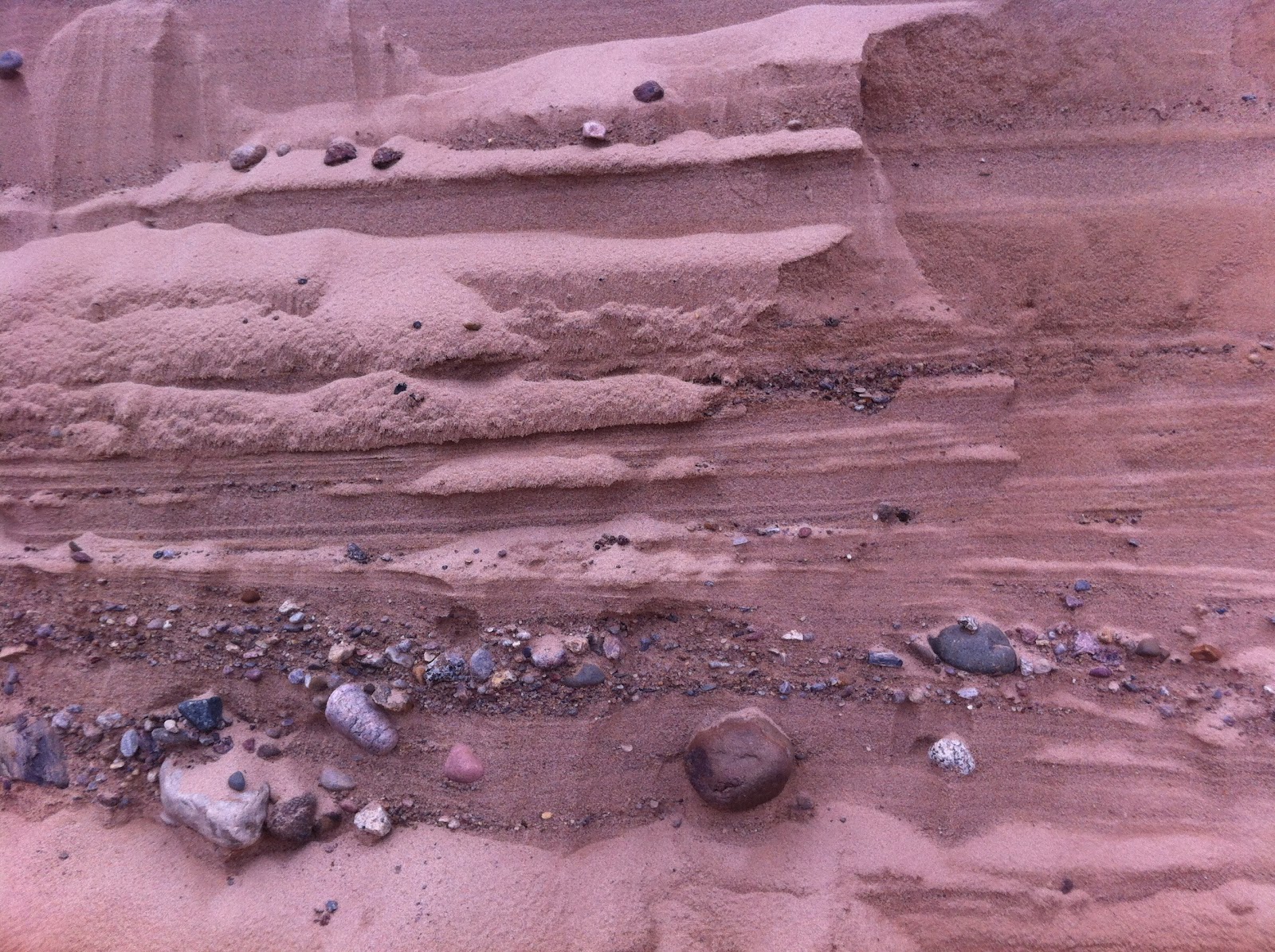
As the Scandinavian Ice Sheet advanced toward Valdai, the constant melting of ice at its margin produced torrents of sediment-choked streams. Modern sandurs, or glacial outwash plains, are best known from Iceland. They are dynamic landscapes that are reshaped constantly by deposition of sediment that was eroded from the continent and locked up in the ice. Sandurs are preserved in the geological record as thick beds of cross-bedded sand and gravel (Figs. 20–22), due to braided rivers that sweep across the plain in front of the glacier. In fact, the weight of the glacier often forms a ridge many miles in front of the ice (imagine stepping on a floating log to raise the opposite end) that keeps these rivers flowing parallel to the ice margin rather than away from it.

Figure 20: The poorly sorted cross-bed sets that comprise the upper layer likely formed in migrating channels of water before the glacier. Horizontally bedded sand in the lower unit, which lacks much of the gravel component seen above, is more typical of the plains between major channels. In other words, these successive layers record two fluvial (river) environments that were adjacent to each other.
Figure 21: More of that horizontal bedding, though with some coarser grained beds. One can imagine the high energy of flow and massive amounts of water being dumped into the basins at this time.
Figure 22: Closer view of channel cross bedding; very typical of modern braided streams.
Figure 23: This monstrous anomaly cuts through periglacial sediments pictured above. The larger clast size denotes much higher energy flow, and may resemble a proglacial stream that eroded previously deposited sediments as the glacier retreated. The orange color is from goethite and limonite—iron oxide minerals that tightly bound the clasts.
As the Scandinavian Ice Sheet began to melt and recede from the landscape, it left clear evidence of its path. Numerous lakes formed in depressions left by the ice. Erratic boulders carried hundreds of kilometers by the ice now dot the surface. Well, it's not unlike any other glacial landscape, I suppose. But it was my first experience with such landforms and deposits in person!

Figure 24: An erratic boulder, given that its granitic composition cannot be found in this region. This particular traveler came from Finland via a massive conveyor of ice and now rests on top of morainal sediments, which themselves overlie the sandur deposits pictured above. The full sedimentary sequence thus marks the advance, halt, and retreat of the last major glaciation in northern Eurasia.
Figure 25: Varved clay sediments deposited in ancient Lake Ilmen (northwest of Valdai), which has since decreased in volume significantly. The darker layers represent winter deposition, while the lighter bands represent summer deposition. This lake is called proglacial, because it formed in front of the ice as the ice sheet retreated.

Figure 26: If you have seen varves before, these layers may seem a bit thicker than normal. The reason is that the lake was fed at this time (Late Glacial period) by melting ice, which contained abundant quantities of clay-rich sediment that was scraped from the land surface during the glacier's advance.
Figure 27: When clay accumulates 'quickly', it retains excess water that somehow must escape. These minor folds in the varves (called load structures) are evidence of that escape.
Thus far we covered the bedrock stratigraphy from St. Petersburg to Valdai, which recorded deposition between the Ediacaran and Devonian periods in a passive marine margin. After that, we looked at Late Glacial deposits in and around the Valdai Hills region. In the second part, I'll post pictures from along the glacier's retreat (Lake Ilmen back to St. Petersburg) and discuss some of the Holocene changes that took place in northwestern Russia.

Feel free to post questions or comments below regarding any of the pictures and discussion.

Tuesday, September 25, 2012

Feedback RE: Bill Nye's Plea

I felt that the following comment from my previous post (about Bill Nye) warranted its own spot, so I am reposting it here:

Mark H. writes:

"I think that you should consider more the implications of a YEC point of view. Ask yourself this question: What would you do if you believed that the Bible definitely teaches the YEC position? There would then be a conflict between the Bible and mainstream science. How would you respond to it? What would be the rational response? In my view, as I think that there are objectively conclusive/certain reasons to think that the Bible is the infallible Word of God, the rational thing to do would be to accept the claims of the Bible and assume that mainstream science is wrong on these issues. After all, mainstream scientists themselves admit that their convictions are only (very highly) probable, not absolutely certain; and probable arguments, no matter how strong, revert to 0% evidence when up against objectively certain claims.

So for YECs who have this view of what the Bible is and what it teaches, their rejection of the mainstream scientific paradigms on these issues is entirely rational. They are doing exactly what they should be doing. And their attempt to rebuild science on what they take as biblical foundations is entirely appropriate and rational, and we should all join in with them. IF YEC assumptions about the Bible and what it teaches on this issue are valid, all of this follows.

So the real point of controversy, the real issue, is what the Bible is and what it teaches on this issue. The scientific evidence is not the determining factor in this dispute. It is important, but it is rationally overridden by other concerns.

I know you know the biblical issues are important, and thus you have used many blog posts to provide an alternative interpretation of the Bible on these issues. And I also recognize that presenting the scientific evidence clearly can force people to go back and rethink the biblical issues. But I do think it would helpful to consider further the rationality and logic of YEC scientific claims, given certain assumptions.

As you know, I have held this YEC position in the past, and I would hold it still if I had not come to the conclusion that there are legitimate ways of reconciling biblical teaching and mainstream science. I am still agnostic on many scientific claims, but I will not oppose them with any strong conviction, because I do not believe I have the clear backing of God's Word behind me, but just my own non-expert opinion."

––––––––––––––––––––––––––––

Thanks for commenting, Mark. I think your reasoning above is not only clear and concise, but very relevant to understanding how the public discussion over evolution actually works.

"What would you do if you believed that the Bible definitely teaches the YEC position?"

Remember that I held this position for many years, even while studying geology at the university. My response was not unlike your suggestion, and I sought for a means—with absolute confidence—to explain the rock record according to a paradigm defined by what I deemed "biblical history". If the data appeared to support long ages without a catastrophic flood, I had rational reason to believe that our scientific interpretation was not yet up to par.

But my post was not about what YEC's should do or where the real controversy lies, as you put it. My interest is in how YEC's might respond the message of this video and why the video will ultimately be ineffective. I think you made that point well in your comment: they proceed with absolute certitude that their interpretation of scripture trumps any contrary evidence from geology/biology.

I ultimately left that paradigm for two reasons, as you know. First, YEC's were demonstrably wrong in their explanations of geological data and often lied about that data. Moreover, their methods were entirely ad hoc, wherein they would take scientific studies by 'secular' scientists and introduce any arbitrary reason necessary to make their case before a non-expert audience. This is not only bad science, but a morally questionable approach by those who 1) claim to be evangelists and 2) hold graduate degrees and ought to know better.

Secondly, I realized that there is no more certitude in biblical exegesis than in the natural sciences. Each often deals in multiple competing hypotheses/methods to obtain information from a complex dataset, and neither are comparable to mathematic logic, in which following 'the rules' always yields the correct answer. Geology and biblical exegesis are similarly hermeneutical sciences, but when it comes to reconstructing history, radioisotope geochronology (for example) allows for far more numerous tests to verify its assumptions and conclusions than (for example) interpreting the relationship between Genesis 1 and primeval events. We rely on the historical sciences, moreover, even to know whether our copy of Genesis 1 matches those from ancient Israel, let alone to translate it accurately.

This is not to promote skepticism regarding the authority of the biblical text, and you know that I believe the records to be reliable and authoritative. I would suggest, however, that 'our certitude' in what the Bible claims can never trump historical evidence completely because it depends thereupon. You cannot even argue that Genesis 1:1 ought to be translated a certain way without referring to historical evidence that is no less disputable than most geological evidence. Thus I cannot agree that scientific evidence "is rationally overridden by other concerns." I would also dispute the claim that any part of the Bible was intended to or could give us more detailed information about Earth history than the geological sciences. I am convinced that attempts to make the Bible yield such information are anachronistic products of modern hermeneutical methods. If my conviction is valid, then YEC paradigms are not merely illogical, but they place massive, unnecessary stumbling blocks before our society and (more importantly) the doors of the church.

"I will not oppose [many scientific claims] with any strong conviction, because I do not believe I have the clear backing of God's Word behind me, but just my own non-expert opinion."

One of the most fascinating and beautiful characteristics of the biblical text, in my opinion, is its innate ability to transform people and cultures across time and space. One might say that it is the living word of God. But to utilize this aspect of the text requires that we are mindful of its dynamic complexity—its poetics—and that we recognize that the experience of reading the text (its affect on us, the reader) should not be divorced from the academic pursuit of its meaning. In other words, reading scripture in faith is no less important that obtaining the 'true meaning', which often is not so simple and may even depend on the context of the reader. New Testament expositions of the prophets are a prime example, I think. It is this feature, in any case, that separates the secular academic from the Christian academic in the natural sciences. It is in faith that we explore creation just as we explore the revealed Word. One does not trump the other, but both are made sensible by that faith. The very pursuit of knowledge in each discipline produces divinely inspired wisdom, often through getting the 'wrong' answer time and again. Thus if we claim certitude in one field where we have none, we preclude ourselves from much of what God has yet to reveal to us.

Or so I view my own journey thus far, and this rejection is the source of my frustration when YEC hermeneutics become the justification for rejecting claims of modern science and even prevent the student from learning or examining them properly.

Saturday, September 8, 2012

Why Bill Nye's plea will (unfortunately) fall on deaf ears...

My commentary here is a bit late to the party, but I hope still relevant. On a quick personal note, I've spent 40 hours on planes in the past month, covering more than 25,000 miles. Between flights, I spent all my free hours in the laboratory or trying to experience the U.S. one last time before departing on my year long adventure. It's good to be 'home', but it seems I have a lot of news to catch up on, particularly the YEC community's response to the video below.

I imagine that you have all seen Bill Nye's brief comments regarding evolution as a foundational science and the societal speed bumps created by those who deny it. I also predict there would be a mixed reaction among you to his exhortation, even if you generally agree with it. If you're like me, Bill Nye played a large role in developing your childhood fascination with science in action. Now that we are 'grown up', it follows naturally that he check up on his prior audience to remind them what is and is not science (he is also active in promoting the public understanding of anthropogenic climate change).

To put it briefly, I don't mind at all that Bill Nye's popularity is a medium for these messages. In fact, I fully support his efforts and generally agree with his position. Few things are more bothersome to me than celebrity lecturers, but Bill Nye is not merely a likable personality that is passionate about some message. He is also uniquely qualified to teach it. It would seem, therefore, that he is the perfect choice to awaken aspiring parents of young scientists from their dogmatic slumbers. Yet somehow I am skeptical as to whether any YEC parent will be moved to do anything but to remove Bill Nye from their list of childhood heroes. Let's take a look at the video together, and I will explain why this message will (unfortunately) fall on deaf ears:

"The denial of evolution is unique to the United States..."

It is not entirely fair to single out the United States as a unique home of those who deny macroevolution/common descent. These groups are sufficiently popular in several European countries to warrant frequent news coverage, as well as educational offices devoted to supplementing the teaching of evolution (e.g. the British Center for Science Education). Young-Earth varieties are more popular and more successful in South Korea, and anti-Darwinian sentiments dominate public and academic spheres in Turkey. For this reason, YEC parents watching this video may come away with the impression that Mr. Nye has not kept up on current affairs and geography.

Nonetheless, the United States is unique in harboring the most successful 'counter-offenses' to the 1859 revolution, and its ministries (e.g. Answers in Genesis, the Institute for Creation Research) continue to offer unmatched resources to global networks battling the teaching of evolution. Nuanced as such, Bill Nye is not wrong to warn us that whereas the United States ought to be a lighthouse for the nations when it comes to innovative science, she is currently muddying the waters. But for YEC's that see themselves as bearing that very light, this warning must be accompanied by both persuasive and compassionate speech. This video lacks both, in my opinion.

"...the United States is where most of the innovation still happens..."

The United States is and will continue to be a leader in innovative science, medicine, and technology, but largely for economic reasons. We have an abundant supply of funding for these disciplines with a relatively low demand (from the society, that is) for qualified people to fill them. Consequently, countries in which there is a deficit of science funding tend to export top scientists to the United States (not intentionally, of course), where these ex-patriots can pursue their groundbreaking research without financial hindrance. Few of you would have difficulty choosing between $200/month and $8,000/month salary to work as a full-time professor, even if choosing the latter involved leaving your home country. Combine that with the potential for $150,000+ research grants from the National Science Foundation, and you can understand why the U.S. is supported by a wonderfully multinational research base.

What can we expect for the next generation? Consider the following two trends. First, there is growing skepticism for scientific establishments/disciplines whose academic conventions conflict economically, politically, or (somehow) theologically with major communities in the U.S. The result appears to be that scientists are slowly losing their credibility as role models for society (the riposte "but science says!" has all but lost its flavor). Skeptics of evolution, for example, constitute a major voting group that will decide (or vote for officials that decide) how and when and why we fund scientific research and education, and science funding is currently being cut. Secondly, many developing countries (e.g. China, India, and Russia) may soon be able to match American funds, at least to the point that the U.S. is no longer an importer of capable scientists to make up for our slack.

If these trends continue and converge, the U.S. will no longer have the 'luxury' of devoting so many resources to debating major scientific paradigms that, for many, have long been established. So I would support Bill Nye on this point, though I think it should have been explored to avoid misunderstanding (especially for non-U.S. scientists that may feel insulted by his characterization of American ingenuity).

"When you have a portion of the population that doesn't believe in that, it holds everyone back..."

If I were a YEC, I would consider this a victory call. That 'secular' scientists should feel that they are losing their grip of influence on the general population is a well known mission of organizations like AiG. Therefore, it pains me to think how many parents will ignore Bill Nye's reasoning to follow as to how precisely we Americans are 'held back' by their attitude toward science.

"Evolution is the fundamental idea in all of life science..."

Yes. More specifically, evolution is a unifying concept that currently explains the range of phenomena from all aspects of the life sciences. One need not accept evolution to accept this fact. Whether in medicine or in classifying dinosaur bones, evolution is the fabric by which we approach the problem. Since it consistently yields positive results in biological/geological research, has not been contradicted by numerous incoming data (e.g. the Human Genome Project), and currently has no rival theory with anywhere near the explanatory power, the vast majority of earth and life scientists accept it. Yes, evolution is a subject of ongoing research and yes, there are details to be resolved. But by and large, this statement is true.

It has not always been the case, however, that evolution was the unifying concept, and the revolution begun by Darwin's ideas was not the only in history to alter the academic landscape. Therefore, most YEC's will find comfort in the hope that one day, a more palatable concept may replace the theory of common descent, even among secular academics. Perhaps in two centuries, evolution will be consigned to a list of scientific dogmas that died so hard with such a dedicated following.

I suppose a creationist can hope, and I sympathize with this kind of hope. Everyone struggles in trying to reconcile differences between how the world appears and how we hope or believe it ought to be. Even in grieving over the death of a loved one who we think shouldn't have died. We might feel that he/she didn't deserve it, even if we don't believe in any sort of 'cosmic justice'. If you can understand this struggle, then you can understand why YEC's are reluctant to dialogue when told to 'face reality'.

Don't get me wrong here. I am not suggesting that YEC or even Christianity in general is something that people simply accept against all reason or evidence. Every worldview interprets facts through a lens of faith ("brute facts are mute facts") and each bears unique challenges from those facts—some apparent and some real. Consider, for example, the paradox raised by Paul between a suffering church and a victorious King. The Gospel itself is not a palatable answer given because it makes simple sense, but a powerfully subversive one that flies in the face of all we thought we knew.

So should we expect that one day evolution will disappear to the vindication of all skeptics at present? There is good reason to say no. Although evolutionary biology may look quite different in 50 or 100 years, its core principles (common descent, the phylogenetic tree, speciation through natural selection and genetic modification, etc.) have been so corroborated by multiple independent methods and disciplines that they are likely to survive even future scientific revolutions, much in the way that the core of Newtonian physics survived the 20th century.

"...analogous to trying to do geology without believing in tectonic plates..."

A legitimate question is raised as to whether one may be a successful/prolific scientist (particularly a successful biologist) without accepting certain aspects of the evolutionary paradigm. Bill Nye suggests here that "you're just not gonna get the right answer" if you deny evolution, and he cites pre-Plate Tectonic geology to make his point. One can also add Sequence Stratigraphy, which was developed by Exxon Mobil and applied with great success to exploration geology.

In my experience, however, this charge does not hold up. Even today, geologists regularly cite papers that were published before the geological paradigm shifts in the late 70's and 80's because they do, in fact, give many of the right answers. In principle, one can identify ancient coastal margins and correlate sedimentary strata without reference to plate tectonics and sequence stratigraphy. Likewise, it is possible to contribute to the fields of medicine, biochemistry, ecology, and so forth without accepting common descent.

The answers are incomplete, however, lacking a mechanism to explain all the data. One may conduct geological research successfully without accepting the theory of Plate Tectonics, but the conclusions are held back when the most parsimonious explanation is excluded. This, I believe, is why Bill Nye suggests that your "world becomes incredibly complicated" when you deny evolution. It is currently the most parsimonious explanation for similarities in genomic data among primates, for example, or comparative anatomy or the general structure of the fossil record.

Leaving evolution aside for a moment, I hope you will recognize from discussions on this blog how complicated geology becomes when you approach it from a Young-Earth, 'Flood Geology' perspective. Flood geologists reject deep time (billions of years) a priori, so the most parsimonious explanation for trends in radiogenic isotopes is no longer available. Instead, they turn to absurdly complicated (and quite impossible) scenarios in which accelerated nuclear decay produced the observed concentrations of these isotopes. But then another problem arises: the heat produced by enhanced rates of radioactive decay. So an even more complicated scenario is posited, in which cosmic expansion somehow offsets the additional heat. How this could possibly explain convergence between isotopic systems is still unexplained by such models (see the last two posts for more details). Nonetheless, 'Flood Geologists' would prefer to complicate their models ad infinitum before accepting what 99% of their colleagues accept as blatantly obvious—the Earth is much older than YEC's are willing to believe.

But how about the charge that life will "still be a mystery" rather than an "exciting place"? Young-Earth Creationists sincerely believe that because of their faith in 'biblical' creation, life is no longer a mystery. Many are quite enthusiastic about studying natural phenomena, and they have no sense that their foundation is mistaken or unscientific. Therefore, they will swiftly reverse this claim by saying that evolution makes life not only mysterious (there is so much unknown about the origin of life and complex biochemical 'machinery') but also dull and hopeless. It is wonderful that Bill Nye can share his passion for science, but he has little to offer to a dedicated YEC, who conflates the Young-Earth view with a respect for God's message. Since they know the joy that comes with the gospel, they will never believe that 'evolutionists' could match it with a fascination for nature. I too know that joy, and I concur.

"And I say to the grown-ups, if you wanna deny evolution...that's fine. But don't make your kids do it, because we need them."

Perhaps the most quoted section of this video, Bill Nye makes a bold but heartfelt plea for YEC parents not to pass on their denial of evolution for the sake of society. Assumed in this plea is that one cannot be scientifically literate or a successful engineer if one denies evolution. Of course, this assumption is demonstrably not true. Although I disagree strongly with geologists at AiG like Andrew Snelling and Steven Austin, they are scientifically literate and they do understand how science works. They just rebel against that method in favor of what they perceive as 'more biblical' to conduct their own research. I think their methods and conclusions are quite flawed regarding Earth history, but it does not prevent Andrew Snelling, for example, from consulting with a mining company and identifying an economically significant ore body. Likewise, engineers who are creationists can and have 'built stuff', including the rockets that delivered American astronauts to the moon.

I have not yet delved into the responses to this video by YEC's, but I predict that most will drive at this point first. They will reach into their list of 'famous scientists that believed in biblical creation' to show that one can be a successful scientist and deny evolution. Perhaps next post, I will focus on specific responses. But for now, I think this tried tactic begs the question. If I am studying sedimentary geochemistry, for example, does it matter where I stand regarding the latest in psychoanalytical theory? Very few scientific disciplines, especially in engineering, are held back in practice by the denial of macroevolution and common descent, even if evolutionary theory helps to explain them better. This is true even of many fields in medicine.

Bill Nye's main point, however, drives at the bigger picture: what is our attitude as a society toward the natural sciences if a large portion of the population is willing to reject major unifying paradigms on the word of a handful of dissidents? Will it continue to progress, or will even the developing world soon pass us by? Will we always have the luxury to debate the finer points of biochemical evolution in bacterial flagellum and how to qualify the teaching of evolution in public schools?

The world is not so static. If these questions do not seem pertinent now, give it a few years. I think they are worth considering, whether or not Bill Nye's message will be received by any YEC parents. My prediction is that, unfortunately, it will not.

Tuesday, August 7, 2012

Why does Andrew Snelling use RATE team funding to falsify his own claims?

I would like to suggest that if you have donated money to the Radioisotopes and the Age of The Earth (RATE) team—either directly or by supporting ICR and Answers in Genesis—then Dr. Andrew Snelling has spent that money to discredit your beliefs regarding the age of the Earth. Unfortunately, he reports this research through 'technical' articles that are unintelligible to much of his audience, and therein he hides the fact that the results actually contradict his professed beliefs. In other words, Dr. Snelling depends on the ignorance of his readers regarding geology—specifically geochronology, which entails various methods of dating rocks. Let's take a closer look, using Snelling's article on Mt. Ngauruhoe, New Zealand as an example.

Radiogenic isotope data in volcanic island arcs

If you read my previous post (The Orinoco Flow) and subsequent comments, then you are already familiar with some of the methods by which geochemists investigate tectonic processes at subduction zones (like the Lesser Antilles volcanic arc). Radiogenic isotopes (i.e. those produced by radioactive decay) are essential tools in quantifying the tectonic interplay between oceanic sediments, subducted crust, and the upper mantle—all of which contribute to magma generation that produces oceanic island chains. To date, geologists have thoroughly documented the influence of oceanic sediments—even specific river basins—on the isotope geochemistry of volcanic rocks around the world. The most relevant conclusion to this blog/discussion is that the subduction of oceanic crust was accompanied by the slow accumulation of sediment in the deep ocean over tens of millions of years. Conversely, Young-Earth models do not predict the isotopic data at volcanic island arcs, primarily because they offer no model by which the mantle and crust evolved to drastically different isotopic values.

Ratios of radiogenic isotopes can be combined with geochronological data (radiometric dates) to elucidate tectonic processes over time. The most common (and accurate) way to date such rocks is to apply the U-Pb method to zircon crystals in volcanic rocks. These crystals are quite small and rare, but are incredibly resistant to chemical alteration. In other words, geologists can use independent lines of evidence to study the history of these rocks: one isotopic system (U-Pb) to date the rocks and several others (Sr-Rb, Sm-Nd, Lu-Hf, etc.) to distinguish the origin and ascent of the magma.

As an aside, the oldest zircons to date were found in the Jack Hills of western Australia and date as old as 4,404±4 million years (see the PDF of the original article by Wilde et al., 2001). I raise that point here as a brief example of how these geochronological data look, since you can see the photos, figures, and data tables for yourself in this original Nature article. Note in particular the reproducibility of dates and the sample size (a circle ~40–50 millionths of a meter in diameter).

Figure 1b from Wilde et al. (2001), showing CL image of sampled detrital zircon.


"The Relevance of Rb-Sr, Sm-Nd, and Pb-Pb Isotope Systematics to Elucidation of the Genesis and History of Recent Andesite Flows at Mt. Ngauruhoe, New Zealand, and the Implications for Radioisotopic Dating"

In his 2010 'technical' article (posted at AiG here), Andrew Snelling published the results of another RATE team project, which essentially involved sending very young volcanic rocks to geochemistry labs for a plethora of expensive analyses. Snelling believes that in the brief history of geochemistry, researchers came to discover that radiometric dates—"particularly on oceanic islands", he says—were typically unreliable and anomalously large. Consequently, he wanted to measure a handful of isotopes from volcanic rocks in New Zealand to convince his readers that radiogenic isotope ratios are quite meaningless with respect to the age of those rocks.

In actuality, Snelling's examples of 'unreliable ages' primarily derive from K-Ar determinations that were made before geochronologists knew how to correct for excess argon and xenoliths (bits of old minerals in young volcanic rocks). His stated agenda is therefore unwarranted, since more recent analyses of very young, historical volcanic rocks using the Argon-Argon technique are spot on. One example comes from the Ar-Ar dating of the 79 A.D. Pompeii eruption, which yielded an age of 1,925±94 years and is summarized in a news report here. Another comes from the re-dating of historical volcanic basalts in New Zealand using the Ar-Arg method (Cassata et al., 2008; discussed on my blog here). The work of Guillou et al. (2011), whose K-Ar, Ar-Ar and radiocarbon dates (~30,000 years) of volcanic flows and wood fragments all overlap, further corroborates my point that geologists now have little trouble obtaining reliable dates, even for very young volcanic rocks.

The only geochronological tool employed by Dr. Snelling was the whole-rock K-Ar method, which yielded model ages between zero and 3.5±0.2 Ma (see original article here). This method does not (and cannot) address the problem of excess argon or inherited material, however, so it is not surprising to any geologist that Snelling obtained non-zero ages in half of his 13 samples (that's right, half of his samples yielded the correct age!). Model ages are always contingent on whether the conditions of the model held. Since lava flows in volcanic island arcs are known to contain excess argon and inherited material in some cases, geologists do not expect the model K-Ar age to be the real age. Keep in mind also that these samples were sent to a laboratory without instrumentation sufficiently precise enough to analyze young (less than 2 Ma) samples. This is much like trying to weigh a few grains of sand on the vegetable scale at the grocery store and then complaining that their scales are broken! One must ask, therefore, how Dr. Snelling can effectively discuss 'age data' in these rocks if he refuses to apply any of the commonly used, modern methods in his study. We'll return to this point later.

Before diving into a mash of petrological details, Snelling summarizes a couple of well-known geochemistry textbooks with respect to the general use of radiogenic isotopic analyses in volcanic island arcs. He writes:

"...radioisotopes in [historic/recent] lavas reflect the isotopic compositions of the mantle sources of these lavas, and of any crustal contamination the magmas may have incorporated during ascent and extrusion." (emphasis mine)

This should sound familiar to you by now. It appears that Snelling generally understands that most radiogenic isotope systems in volcanic arcs are not hypothesized to reflect the age of the actual eruption. Nonetheless, Dr. Snelling continues as though geologists believe these isotopes should reflect the age of eruption and admits—albeit slyly—that he has wasted the grant money from the RATE project:

"Because these samples are from recent lava flows (only 28–54 years old), the isotope ratios of these samples were not expected to yield any age information." (emphasis mine)

In other words, after referencing a couple of 15-25 year-old geochemistry textbooks (which all specify that Rb-Sr, Sm-Nd, and Pb-Pb isotopes in volcanic arcs are related to mixing between various mantle and crustal sources), Snelling decided to spend thousands of dollars on a handful of useless isotope data. I say 'useless' because Snelling had no meaningful hypothesis that could be tested by these data. The statement "no age information is expected" is not a scientific hypothesis. Hence, Snelling's article is by no means a 'research' paper, but rather a lab report that contains his educated opinion. In the sciences, we call this "shaking the box"—that is, to perform laboratory analyses just to see how the data will look and then describe the reasons for any trends retrospectively.

Nonetheless, even though Snelling claims that the samples were not expected to yield age information, he understands that these isotopes are radiogenic (produced by radioactive decay) and thus change over time. Dr. Snelling believes that radioactive decay occurred a million times faster within the past ~6,000 years, so within his own paradigm, these isotope ratios should reflect the passage of time somehow. Why not offer a means by which to test the young-earth model with the new isotope data? Unfortunately for Snelling, no such test exists, but with a handful of tables and verbose petrological descriptions, he is successful in misdirecting his audience.

Though he disagrees with conventional models, which say that isotope ratios of rare-earth elements in the mantle (such as Rb, Sr, Sm, and Nd) evolved through melting/recycling of crust and mantle convection, Snelling did not claim—let alone demonstrate—that his data are inconsistent with the accepted geological history of this island arc. Instead, he confuses his readers by leading them to believe that geologists typically construct Rb-Sr, Sm-Nd, and Pb-Pb isochrons and calculate Nd-model ages from continental volcanic arc samples—they don't. As in the previous example from the Lesser Antilles, geologists are interested in these isotope ratios primarily to learn about the history of subduction, composition of the mantle, and how oceanic sediments and crust are incorporated back into the mantle. For that purpose, isotopes of Sr, Rb, Sm, Nd, and Pb are extremely useful (e.g. Hart, 1988) and have been used to construct coherent models of mantle convection and mantle sources. In fact, Snelling's numerous tables and figures are perfectly consistent with the notion that volcanism in New Zealand results from the subduction of oceanic sediments on the Pacific Plate several million years ago.

No age information?

Given the dubious tactics employed by the RATE team, one should question whether Snelling's conclusion is even correct, that the isotopic data yield "no age information". Besides the brief discussion on K-Ar dates (see below), Snelling offers a strange and rather mysterious review of Rb-Sr and Sm-Nd data:

"Selective plotting of the data does yield some seemingly valid isochrons, such as a 5-point Rb-Sr isochron yielding an apparent age of 133 ± 87 Ma and a 5-point Sm-Nd isochron yielding an apparent age of 197 ± 160 Ma. The “goodness of fit” statistics for these two isochrons yield low MSWD values... However, the probabilities of these fits being meaningful are only moderate and the assigned error margins on each of the determined isotopic ratios required to constrain the fits are intolerably large, resulting in final error margins that are more than 50% of the apparent isochron ages. Such selective manipulation of the data is thus not only misleading, but completely meaningless." (emphasis mine)

As an aside, why would a 'technical article' contain phrases like "goodness of fit statistics"? In any case, Snelling begins with an admission that he only calculated a model isochron age after cherry picking the data. Although 10 data points are available, he chooses 5—why? Apparently, Snelling wants his reader to have the impression that geochronologists arbitrarily choose their data to make the best possible fit. Of course, this is not true, but his silence on the topic leaves one to make the false assumption.

The actual (mathematical) result of cherry picking these data is an inflated margin of error (which he then complains is "intolerably large") and the option for Snelling to pretend that the isochron ages are 133 and 197 million years, respectively! When the YEC reader is told that 30-year-old volcanic flows yield isochron ages >100 million years with ridiculous margins of error, he/she is bound to believe mistakenly that Snelling's experimental data discredit radioisotope dating. Snelling makes no effort to guard against this misperception and is thus guilty of deceiving his audience. Let's take a look, rather, at how Snelling's full datasets plot:


If you are familiar at all with isochron plots (cf. Figure 5), then you already know that the flat lines imply a zero age. In other words, Snelling's isotope data did reveal age information! The age of these volcanic rocks, according to the Rb-Sr and Sm-Nd isotope systems, is consistent with the known ages of ~30–60 years. As Snelling notes, the line is statistically valid even with 5 points (MSWD < 1). The slightly non-zero slope on my plot results only from analytical uncertainty. As I mentioned, however, the isochron method is not typically employed for such systems because 1) chemical alteration can falsify the model assumptions, and 2) the U-Pb and Ar-Ar methods are far more accurate and less susceptible to and affected by chemical alteration.

Pb-Pb isochron

Snelling discusses only briefly the results of his lead-isotope data:

"...better apparent results are obtainable with the Pb isotopic data, a 7-point isochron yielding a 207Pb-206Pb age of 3908 ± 390 Ma. The statistics of this fit are much better, with small error margins for each data point and a reasonable MSWD value of 1.07, but the probability of the fit is only moderate and this apparent isochron has intercepts with the Pb isotope growth curve at -92 Ma and 3921 Ma. For comparison, the Pb isotopic data also yield a 9-point 208Pb-206Pb line of best fit with a low MSWD value of 0.45 and a high probability of 0.87."

Again, no graph is provided with the above description, nor any explanation as to why only 7 or 9 points are used (rather than all 10 from Table 2). More importantly, Snelling spends no time discussing why this apparent isochron yields an age of ~3.9±0.4 billion years. Since the volcanic arc system obtained Pb from various sources in the mantle and crust, the apparent isochron reflects the time since the Pb in these volcanic rocks were last part of the same reservoir (let's say, the mantle of the early Earth?). In other words, this apparent age (apparent because it has nothing to do with the age of volcanism) tells how long ago the mantle began to separate into different parts, such as continental crust and upper and lower mantle. Once again, therefore, Snelling's isotopic data do yield some age information, contrary to his stated anticipation. These data suggest, however, that the mantle and crust have been decaying radioactively for nearly 4 billion years.

At this point, Dr. Snelling should explain why the YEC model better explains these data than conventional models of Earth history. However, he avoids mentioning that his data (funded by YEC ministries) actually support modern geology (and those pesky 'evolutionists'). Instead, he escapes scrutiny and raises readers' doubts with the following nonsensical interpretation:

"These outcomes would thus seem to have some validity and meaning to them, implying some significance to these trends in the Pb isotopic data."

Sadly, this sentence is worth quoting back to any YEC that complains about being rejected by peer-reviewed journals. One cannot write a 'technical journal article' with no hypothesis and then conclude that the results 'seem' to be valid with 'some significance' without even explaining why the results (which are consistent with previously published results and interpretations) better support your interpretations.

In summary, the result of Snelling's work is twofold: 1) the isochron method works, despite Snelling's thousands-of-dollars effort to prove otherwise; and 2) the YEC worldview offers no alternative model by which to understand these data, which seem to falsify its own claims. Sr, Rb, Sm, Nd, and Pb isotopic data from Mt. Ngauruhoe, New Zealand are all consistent with a 4.5 billion-year-old Earth, which began to differentiate geochemically into various mantle domains early in its history.

K-Ar dates and "being thorough"

To add more fuel to his readers' skepticism of radioisotope methods, Snelling briefly cites his own 1998 paper, for which he obtained Potassium-Argon model ages on a ~60-year-old lava flow. These ages ranged from 0–3.5 Ma (million years). Although the laboratory was not equipped to analyze samples less than ~2 million years old or to account for xenoliths (i.e. tiny bits of material much older than the actual volcanic flow), Dr. Snelling felt convinced that "excess [Argon] had been inherited by these magmas during their genesis in the upper mantle, and therefore has no age significance."

On the contrary, these data have some "age significance"—Dr. Snelling simply declined the opportunity to interpret them scientifically. In short, he could have analyzed these samples in a modern K-Ar or Ar-Ar laboratory—the latter of which can more easily distinguish excess and inherited argon. Regardless, when margins of error and crustal contamination are taken into account, Snelling's K-Ar model ages are effectively zero for the volcanic eruption itself.

After stating that no "age information" was expected from isotopic analyses, Dr. Snelling makes another misleading and unscientific claim:

"Nevertheless, a thorough analysis of the data was still undertaken to test for any “age” information they might still yield."

Dr. Snelling's 'thorough analysis' was unscientific because he did not define any method by which he would 'test for age information' (remember the cherry picking and disregard for complete data sets?). This statement is also misleading because his analysis was anything but thorough. For a study 'published' in 2010, whose budget was not limited, Snelling should have employed the most common precision geochronometers: the Ar-Ar and U-Th methods.

Why didn't Snelling perform these analyses?

One can only suspect that he was not interested in geological research, but a fancied petrological report (which he interprets occasionally as a consultant). The latter offers little scientific value, but allows Snelling to convince his target audience of unsupported claims—namely, that Sr, Rb, Sm, Nd, and Pb isotopes are unrelated to geological age and that geologists cannot accurately date young volcanic rocks. In summary, Dr. Andrew Snelling spent thousands of dollars—donated by AiG ministry supporters, themselves convinced of Young-Earth Creationism—on a project that only demonstrated the reliability of radiometric dating and supported conventional interpretations of radiogenic isotopes in volcanic arc systems. Snelling hid the significance of his results from the reader, however, in verbose, semi-technical writing, to which he concluded:

"Even though radioisotopic decay has undoubtedly occurred during the earth’s history, conventional radioisotopic dating of these rocks therefore does not necessarily provide valid absolute “ages” for them. This is especially so if accelerated nuclear decay accompanied the catastrophic operation of those geologic and tectonic processes responsible for the mixing of the radioisotopic decay products during magma genesis." (emphasis mine)

Snelling did not employ conventional radioisotope methods to date these rocks (Ar-Ar and U-Pb), so his first conclusion is unsupported. Nonetheless, whole-rock K-Ar ages are effectively zero, while Rb-Sr and Nd-Sm isochrons do plot on a zero-age line and so accurately reflect the absolute age of the rocks. The notion of accelerated nuclear decay—perhaps the most absurd scenario postulated by YECs—is unnecessary, therefore, to his conclusion. In any case, Snelling should explain to the reader precisely how and why accelerated nuclear decay would affect these isotope systems. The difference in isotopic ratios (e.g. 87Sr/86Sr) between the mantle and crust, for example, requires that one reservoir inherited more Rubidium than the other, after which both reservoirs underwent some ~4 billion years worth of radioactive decay. When did this happen in the Young-Earth timeline? Furthermore, according to Snelling's paradigm, why does the crust contain more Rubidium and less Samarium than the mantle? Was it simply created that way? This phenomenon is well explained by experimental geochemistry (see last post), but requires arbitrary, ad hoc assertions on the part of YECs.

I hope that by this point, you can better recognize the sly tactics of the RATE team and will pray for them to cease from taking money from hopeful supporters—all of whom are evangelical Christians that trust the judgment of AiG researchers. The RATE team results do not support the notion of a young Earth, but rather corroborate the conventional tectonic model in which the Earth evolved chemically over sever billion years. Your money is better spent tending to the widow and the orphan.


References Cited

Hart, S. R., 1988, Heterogeneous mantle domains—Signatures, genesis and mixing chronologies: Earth and Planetary Science Letters, v. 90, p. 273–296.

Wilde, S.A., Valley, J.W., Peck, W.H., and Graham, C.M., 2001, Evidence from detrital zircons for the
existence of continental crust and oceans on the Earth 4.4 Gyr ago: Nature, v. 409, p. 175–178.

Saturday, July 28, 2012

RE: Comments on sediment subduction; case of the Rb-Sr decay system

Regarding the last post, Mike wrote:

"Thanks for posting this, but it's so technical that I doubt many people can follow it. Could you put in a little summary with a simple diagram or two? I think what it means is that the evidence shows that sediment from very old crust has been carried down the river, deposited on the ocean floor, subducted, and re-emerged in volcanism, and that all this is impossible in a short time frame. Is that the general idea??"

Thank your for the feedback. Please forgive me for the technical level. I found it difficult to condense the papers into a manageable narrative without oversimplifying. I hope to keep your attention, however, because these isotopic systems are discussed regularly and at length in YEC circles. In fact, they are even offered as evidence for a young Earth (!??!).


In any case, the short answer to your question is yes, you have understood correctly.

Isotopic ratios (especially of Sr, Pb, and Nd) in volcanic arcs show evidence of 'contamination' by oceanic sediments. But not just any sediments—as you keenly noted—very old sediments that eroded from very old continental crust. In the case of the Lesser Antilles, each element tells the same story: the Orinoco River basin had to be in place and depositing sediment into the western Atlantic before the ocean crust was subducted beneath the Caribbean tectonic plate. It is worth noting that this phenomenon appears not only in the Lesser Antilles but—well, every island arc around the world. Since YEC's and 'Flood geologists' would have us believe that plate tectonic movements happened very fast during/after the Flood (i.e. before these river basins formed), their model would not predict such trends in the isotopic data (in which you see perfect mixing lines between the upper mantle and modern oceanic sediments). Rather, their model is falsified by these data, even if we grant that the subduction of oceanic crust and the volcanic eruptions that produced the island chain could have occurred within ~5,000 years.

But we won't grant such a scenario, because it is physically absurd (not to mention, it misses the whole point of the flood narrative, both theologically and historically).

Hopefully this confirms that you followed the article better than you thought. However, I made a few quick figures to better explain the whole process, focusing on the Rb-Sr system. Let's begin with the first figure from the last post:


When the continental crust that now underlies much of South America formed, it incorporated a relatively high amount of Rubidium compared to what was originally in the mantleThe reason is that Rubidium does not 'fit well' into the solid structure of the mantle, and so it is excluded preferentially when part of the mantle melts. This process is well documented by experimental petrology. When you melt a rock like peridotite—a close match to the composition of the mantle—the bulky elements with large ionic radii (pretty much everything on the left side of the periodic table) are concentrated in the melt. That melt eventually produces continental crust. The result is that continental crust has, on average more radioactive Rubidium (87Rb) than the mantle. Over time, therefore, the crust will accumulate more radiogenic Strontium (87Sr) than the mantle. In this fashion, we can distinguish Strontium derived from old continental crust versus a young piece of basalt (the ratio of 87Sr/86Sr is much higher in the former; see Fig. 1).

To visualize the accumulation of radiogenic Strontium in various minerals, consider the following figure:


In this graph, there are three isotopes of which to keep track. The first is 86Sr, which is stable. It's concentration does not change over time, because it does not decay and is not produced by decay. The second/third are 87Rb and 87Sr, which are radioactive and radiogenic, respectively. Over time, 87Rb decays into 87Sr, so the abundance of the former drops while the latter grows.

Geochemists are more interested in ratios, however, and so I have plotted the ratio of 87Sr (radiogenic) to 86Sr (stable) in yellow. Notice that since there was relatively little 87Rb to begin (the blue is much smaller than the gray), the ratio of gray vs. green changes very little with time. From this graph, you can understand why the 87Sr/86Sr ratio of depleted mantle (which contains almost no Rubidium) has changed very little in the past 4.5 billion years (cf. Fig. 1).


For continental crust, which contains a relatively high concentration of Rubidium, the process is the same but the rates are different. In this case, we have more 87Rb to start—relative to 86Sr—so the ratio of 87Sr to 86Sr changes more rapidly with time. This graph explains the high slope of continental crust in Figure 1, as well as the high 87Sr/86Sr ratios found in very old granites (e.g. the Canadian Shield and, of course, the Orinoco watershed).

We might also point out that since the half-life of 87Rb is ~48 billion years, the most important element here is time. Without a lot of time, there is no known mechanism by which to form minerals with such drastically different 87Sr/86Sr ratios. Some YEC's will try to redirect your attention to things like 'accelerated nuclear decay', but the explanation is 1) ad hoc, made up only to rationalize why the data contradict their hypothesis; 2) physically absurd, since a 1-million-fold increase in decay rates would produce enough heat to melt the Earth; and 3) completely arbitrary and even contrary to orthodox notions of divine providence, in which God does not produce random miracles just to make it appear geochemically that mountain ranges and volcanic islands formed through a more elegant and ancient process.

Just to complete, the following (roughly drawn) figure illustrates how mixing appears between modern oceanic sediments and the upper mantle in the case of Strontium isotopes:


As I mentioned, the process is much like mixing yellow (mantle) and blue (sediment) paints, which produces some hue of green in between. The precise hue depends on the extent to which mixing occurs between the reservoirs. Nonetheless, data from multiple isotopic systems converge on one story—that of an incredibly slow process by which the mountains were 'transferred' from one place (the Orinoco watershed) to another (the Lesser Antilles island arc).

I hope this clears up any questions that arose from my previous post. Feel free to continue any discussion below or by e-mail.

Sunday, July 15, 2012

The Orinoco Flow: sediment subduction and the Lesser Antilles volcanic arc

Radiogenic isotopes and the origin of volcanic island arcs

Isotopes are amazing geochemical tools. They can be used not only to date minerals radiometrically but to constrain small and large-scale geological processes. The subduction of oceanic sediments into the mantle is one such process, about which geologists want to know: what is the ultimate fate of ocean-bottom sediments? For example, what portion of these sediments is taken down into the mantle? How much is scraped off onto the accretionary prism? And finally, what portion of oceanic sediments are melted and returned to the surface through volcanism?

Some of the most important isotopic ratios used to answer these questions are also used in radiometric dating: 87Sr/86Sr, 143Nd/144Nd, 206Pb/204Pb, 207Pb/204Pb, 208Pb/204Pb, 176Hf/177Hf, and even 10Be/9Be. In each of these ratios, one isotope is radiogenic (produced by radioactive decay) and the other is stable. This ratio changes over time, therefore, based on the concentration of the radioactive parent element (Fig. 1). Since the isotope 87Rb decays into 87Sr, for example, the 87Sr/86Sr ratio will increase at a faster rate in minerals with a higher concentration of Rubidium than in minerals with zero Rubidium (i.e. if no Rb is present, the 87Sr/86Sr ratio will never change).

Figure 1: Isotopic evolution of 87Sr/86Sr over time in various Earth reservoirs.

The application of this principle to geochronology is straightforward: if the original isotopic ratio and decay rate can be determined, then so can the age of the mineral. But what does this have to do with plate tectonics, subduction zones, and island arcs in particular?

Consider the Lesser Antilles volcanic arc—that parabola of paradise off the north coast of Venezuela. These islands have been forming through volcanic eruptions over the past tens of millions of years, as Cretaceous-aged basalts and sediments were subducted beneath the Caribbean tectonic plate (Fig. 2). A portion of these rocks/sediments then began to melt upon reaching a depth of ~100 km, causing magma to ascend toward the surface and mix with the upper mantle (check out a visual explanation here). Since the subducted crust/sediment and the upper mantle are of different age and composition, their isotopic ratios will also be distinct (remember how and why these isotopic ratios change?). The final product (surface volcanic rocks) depends of the relative contribution of each, much like mixing yellow and blue paint in varying quantities to produce different hues of green. This geochemical variation is the key to answering the aforementioned questions for each volcanic arc around the world.

Figure 2: Age of basaltic oceanic crust (K-Ar method) currently being subducted beneath the Lesser Antilles island arc. Note that radiometric dates increase systematically from north to south, as expected from the geometry of the crust (distance from the spreading center) and the current plate movement of ~2 cm/yr. In other words, rocks that are 400 km further from the spreading center (the star marked 'Barbados' vs. the northernmost age) are about 20 million years older (~400 km divided by 2 cm/yr is 20 Ma; 105 Ma - 83 Ma = 22 Ma). From Carpentier et al. (2008).
From mantle to crust

Now take a step back in time, to an ancient Earth where massive continents do not yet exist. Much of the Earth's upper mantle would have had a very similar isotopic composition for elements such as Sr, Nd, U, and Pb. As early as ~4.3 billion years ago, basaltic crust began to crystallize at the surface. In the 'short' interval between ~3.5 and 2.5 billion years ago, a majority of continental crust also formed, and the mantle and crust became geochemically isolated reservoirs. Since the process of crystallization always prefers certain elements over others (smaller elements over bigger ones), each reservoir developed unique relative abundances of parent/daughter pairs. For example, the relative abundance of Rb vs. Sr is higher in the crust than in the mantle, so the isotopic ratio 87Sr/86Sr increases faster over time in crustal rocks than in the mantle. On the other hand, Sm vs. Nd is higher in the mantle than in the crust, and so the isotopic ratio 143Nd/144Nd increases faster in the mantle than in crustal rocks. Since 238U decays to 206Pb, relatively high abundances of Uranium (as in crustal rocks) contribute to higher 206Pb/204Pb ratios in continental crust.

In short, high 87Sr/86Sr and 206Pb/204Pb ratios accompanied by low 143Nd/144Nd ratios are good geochemical signatures of very old continental crust. Unless, of course, one can propose a viable alternative mechanism to explain their origin and evolution.

Sediment contribution over time to the Lesser Antilles archipelago

In the following graphics, one can see how geologists apply these isotopic systems to understand the contribution of subducted sediment to volcanic eruptions. First, we need to determine the 'hue' of our yellow and blue paints (i.e. the mixing 'end-members'). On the one hand, we have upper mantle that resides directly beneath the volcanic islands. The isotopic composition of the upper mantle is relatively easy to determine, since it is continually sampled and preserved by Mid-Ocean Ridges (MORs). Dredging ships frequently collect samples of Mid-Ocean Ridge Basalt (MORB), which are then analyzed for their isotopic and elemental compositions, as well as their magnetic polarity and age. Not surprisingly, MORBs from around the world are geochemically very similar. Furthermore, their distinct geochemistry is consistent with theories that the chemistry of the upper mantle is due to the formation of oceanic crust early on in Earth history (see previous section).

Our second mixing end-member is formed by clay-sized particles that sink to the bottom of the ocean. The origin of these particles is found on continents, where old continental crust is weathered and carried out to sea by major rivers. Fortunately, the ocean sediments being subducted beneath the Lesser Antilles have also been sampled in many places by the Deep Sea Drilling Project (the stars in Figures 2 and 3 represent such sites) and analyzed geochemically.

To determine the extent of mixing between these end-members, volcanic rocks are sampled along the arc. Figure 3 is taken from one study that focused on the petrologically diverse island of Martinique, which developed in multiple stages of a long eruption history. Since the volcanic island formed over the past 25 million years, the authors were able to address this question for much of the Cenozoic.

Figure 3: From Labanieh et al. (2010). Map of the Lesser Antilles volcanic arc and Martinique island, for which three stages of the island's volcanic history are delineated. Sampling sites of ocean sediments (stars) and volcanic rocks (see inset) are also shown. As an aside, note the width of the accretionary prism (distance between the 'Subduction trace' and the 'Prism front'). How long must this subduction zone have been collecting sediment?
One can predict the composition of the final product by plotting the isotopic compositions of both end-members on a graph with isotopic ratios on each axis (Fig. 4). The more that subducted sediments contributed to magma generation in the subduction zone, the closer those values will plot to modern isotopic ratios of oceanic sediments (dark gray fields):

Figure 4: From Labanieh et al. (2010). Four isotopic cross plots from Martinique Island,  indicating a significant contribution of oceanic sediments during magma generation (up to 20%). Red/Blue lines are mixing lines between MORB values and ocean sediment values. The range of compositions of Mid-Ocean Ridge Basalts between 30°N and 30°S are shown in light gray fields.
It is evident from the examples above that the composition of volcanic rocks on Martinique Island are due to a mixture between the upper mantle and subducted oceanic sediments. One can also see how the extent of mixing is variable in time and space (Fig. 5). For example, note how the mixing lines—blue vs. red—shifted slightly when the arc itself moved west (cf. Fig. 2). This westward shift in volcanism was possibly due to a shallowing of the angle of subduction following the subduction of an aseismic ridge around 6–7 Ma (Labanieh et al., 2010). In any case, the isotopic mixing trends seen at Martinique Island are common to the rest of the islands of the Lesser Antilles and are prime examples of this phenomenon of plate tectonics. These data also corroborate the theory elegantly, since they are predicted directly by it.

Figure 5: From Labanieh et al. (2010). Relative contribution of oceanic sediments over time, based on K-Ar dating of individual volcanic rock samples. After 5.1 Ma, the end-member composition changed, possibly due to the subduction of an aseismic ridge on the Atlantic Plate.

The Orinoco Flow

Figure 6: From White et al. (1985). Isotopic con-
tours show more radiogenic Sr and Pb in front of
the Orinoco River delta. Results are similar when
Nd isotopes are plotted.
What is the source of deep-ocean sediments being subducted between the Caribbean tectonic plate? One key to answering this question is the geographic variation in isotopes along the Lesser Antilles arc. Nearly 30 years ago, White et al. (1985) documented the modern influence of the Orinoco River on the isotopic composition of sediments lying immediately in front of the Caribbean Plate (Fig. 6). Since the Orinoco River watershed drains sediments derived from very old continental crust (the Archean-aged Guiana Highland), 206Pb/204Pb and 87Sr/86Sr ratios become higher as one moves closer to the river delta. We can predict, therefore, that these isotopic ratios are higher in volcanic rocks from the Southern Islands than in those from the Northern Islands.

As it turns out, that is precisely what White et al. (1985) and later researchers found. Although the debate regarding the significance of this mechanism is not yet fully settled (Carpentier et al., 2008), it is generally agreed that the Orinoco River basin has long been in place (since the Cretaceous) and contributed sediments enriched in radiogenic isotopes to the subducting slab.

Figure 7 represents a cross-plot of Nd and Pb isotopic data from the island arc. As you may recall, the relatively high 206Pb/204Pb and low 143Nd/144Nd ratios are characteristic of old continental crust. Such values (note the Site 543 sediments field) are represented more by the Southern Islands than the Northern Islands. This trend suggests that the geochemistry of volcanic rocks along the Lesser Antilles arc is strongly determined by the geochemistry of oceanic sediments in front of the arc.

Figure 7: From Carpentier et al. (2008). Cross plot of Nd and Pb isotopes showing greater contribution of oceanic sediments in the Southern Islands than in the Northern Islands.
To add some icing to our petrological cake, Carpentier et al. (2008) also demonstrated that Uranium-rich black shale units, which were deposited during the Late Cretaceous Oceanic Anoxic Events (OAE I and II), could account for anomalously high 206Pb/204Pb in the Southern Islands, since they are present only in sedimentary strata to the south. Over time, 238U decays to 206Pb, so the ratio of 206Pb/204Pb will increase at a faster rate in U-enriched sediments relative to the crust or mantle. What does all this mean? Even the islands of the eastern Caribbean can attest that the oceanographic events responsible for these black shales (a long-term reduction in available oxygen to the oceans) occurred more than 80-million years ago, while the Atlantic plate was being subducted slowly (about 2 cm/yr) below the Caribbean plate.

Conclusions and implications for YEC

Corroborative evidence is still being discovered for Plate Tectonic theory, which revolutionized geological disciplines in the 1970's. The Lesser Antilles volcanic island arc is a prime example of the phenomena associated with the subduction of oceanic crust and sediments. Combined isotopic data from numerous elements demonstrate how conventional theories regarding the Earth's age and history can be tested through multiple, independent methods. Simultaneously, one can see how such theories are potentially falsifiable, since they were formulated before the isotopic data were available, yet were able to predict trends in those data. If you were able to follow the examples above, I hope you will better understand how geology has progressed scientifically (rather than through conspiracy and ideology).

Young-Earth Creationism has attempted to keep up with modern geology by transforming Plate Tectonic theory (which describes a notably slow process) into 'Catastrophic' Plate Tectonics—a process that barely works on paper, but so rapidly that it would have boiled off most of the oceans. The latter is hotly debated within YEC and not accepted by many. Personally, I would predict its disappearance in the near future if it weren't so necessary to accepting the obvious evidence for Plate Tectonic theory. It will be interesting to see whether YECs make any attempt to adapt to the flood of new evidence for the theory's more conventional version.

Despite the fact that Catastrophic Plate Tectonics is an abstract, geophysical model (i.e. difficult to grasp or critique by the layman—myself included), one can ask whether it accurately predicts the relevant evidence. For example, how does Catastrophic Plate Tectonics explain the isotopic data presented above from the Lesser Antilles? How did the South American continent crystallize from molten rock (a slow process in itself), decay radioactively to produce distinct Nd, Sr, and Pb isotopic values (a 2.5 billion-year process), deform structurally (to form major river basins like the Orinoco), weather extensively (to fill the North Atlantic basin with fine-grained sediment, which typically needs thousands of years to settle at the ocean bottom), and yet be covered with miles of Phanerozoic sediments? When the big picture is considered as a whole, the YEC mentality becomes a fleeting illusion.

Radiogenic isotope data from the Lesser Antilles arc seem to indicate that oceanic sediments have long been weathering out of the Orinoco River watershed, subducted beneath the Caribbean Plate, and melted and incorporated into the magma that produced the idyllic islands of the eastern Caribbean. Radiometric dating of volcanic rocks and oceanic crust corroborate the picture interpreted from radiogenic isotope data (Fig. 2), and are even predicted by modern rates of subduction and distance from the trench to the spreading center. The Beryllium-10 method (which I will discuss in a later post) provides an additional test to determine that the process of subduction occurred over several million years rather than several hundred.

Catastrophic Plate Tectonics and YEC cannot account for the isotope trends in volcanic arcs, because they provide no mechanism by which distinct isotopic signatures form in a matter of hundreds or thousands of years. Furthermore, these paradigms cannot explain the origin of massive amounts of continentally derived sediment, which were subducted beneath oceanic plates before the modern tectonic picture formed (i.e. before the Flood). I will return to this point in the next post when I discuss Dr. Andrew Snelling's article entitled "The Relevance of Rb-Sr, Sm-Nd, and Pb-Pb Isotope Systematics to Elucidation of the Genesis and History of Recent Andesite Flows at Mt. Ngauruhoe, New Zealand, and the Implications for Radioisotopic Dating", in which he cunningly misrepresents the geochemical methods employed to understanding volcanic arc systems.

If this post was sensible to you, his errors will be obvious.


References Cited:


Carpentier, M., Chauvel, C., and Mattielli, N., 2008, Pb–Nd isotopic constraints on sedimentary input into the Lesser Antilles arc system: Earth and Planetary Science Letters, v. 272, p. 199–211.

Labanieh, S., Chauvel, C., Germa, A., Quidelleur, X., and Lewin, E., 2010, Isotopic hyperbolas constrain sources and processes under the Lesser Antilles arc: Earth and Planetary Science Letters, v. 298, p. 35–46.

White, W.M., Dupre, B., and Vidal, P., 1985, Isotope and trace element geochemistry of sediments from the Demerara Plain region, Atlantic Ocean: Geochimica et Cosmochimica Acta, v. 49, p. 1875-1886.

Tuesday, July 3, 2012

"Orthodox at Heart"—a personal reflection on the church in Russia

Such is the title of my guest post over at The Two Cities blog. If you're interested in the topic, please check it out and feel free to comment on the article at either site.

Much could be said in comparison of American and Russian churches. One topic at which I only hinted (but didn't have room to explore), is that of the relationship between the church and our respective  political revolutions (in 1775 and 1917). Both revolted against monarchist states, accused of exploiting the wealth and prosperity of the people while infringing on individual rights. Both led to quasi-secular nations that broke with the European tradition of a state church. In the American case, however, religious freedom was emphasized as a divine right, and the replacement oligarchy touted a quasi-Christian deism, in which God could be found through academia (forgive the oversimplification). For Russia, religious freedom was promoted only to undermine the Orthodox Church (associated with the strength of the Imperial upper classes), but later squashed through censorship and persecution. As a result, continued health of the Soviet Union relied on a new standard of orthodoxy, and to stray from such made one an enemy of the State. Despite the ostensible opposition to liberty, this structure secured the government against future revolution, as was seen, for example, in the American Civil War (for Southern Independence) scarcely 85 years after the nation's founding.


As the commemoration of our American Revolution approaches, we might ask ours uniquely bears on modern affairs, mindsets, and particularly the church, compared to those of other countries. Many Russians ask today whether their own revolution marked a positive or justified turn in national history. If we ask the same in America, what kind of answers emerge?


I never thought to ask this question, so I thought I would share.