Exploring the wonders of geology in response to young-Earth claims...

Never been here? Please read my guidelines and background posts before proceeding!

Wednesday, February 12, 2014

"45 thousand-year-old fossil wood encased in 45 million-year-old basalt": Conflict Revisited

One point lost by Bill Nye in the recent debate with Ken Ham was the repeated assertion that YEC researchers had dated fossil wood ~1,000 times younger than the basalt in which it was encased. If the assertion holds, then radiometric dating methods to which Bill Nye appeals as evidence for an old Earth are potentially flawed. Unfortunately, Bill Nye did not seem familiar with the claim, reported originally in 1993, despite my prophetic counsel. ;)

Where did these samples come from, and why were they sent to labs for radiometric dating?

In 1993, several samples of charred and petrified wood were collected during construction of a mining ventilation shaft in central Queensland. The wood samples were seemingly well preserved inside the lava flow that encased them. Since the layers of basalt overlay early Cenozoic sediments, the expected age of the lava flow might be a few tens of millions of years. Not convinced by conventional ages of this geologic column, however, local 'young-Earth' geologists paid to have the basalt dated by the K-Ar method and the wood fragments dated by the radiocarbon method. Their reasoning was simple and seemingly innocent: if indeed the Earth is old, then fossilized wood from an ancient lava flow should contain no radioactive carbon (14C) today and will not yield a finite age; if the Earth is young as we claim, however, then detectable 14C should be present in the fossilized wood and the K-Ar age of the basalt cannot be taken seriously.

A full report of this study by Dr. Andrew Snelling of Answers in Genesis is available for download from the Institute for Creation Research [Snelling, 2000. Creation Ex Nihilo Technical Journal, Vol. 14, No. 2, p. 99-122]. The 24-page publication is rather verbose, reading more like a drawn-out lab report than a scientific study, but it contains all the details necessary to assess the feasibility of Dr. Snelling's extraordinary claims.

Wait, if the fossil wood and basalt are both older than 6,000 years, doesn't Ken Ham undermine his own position by citing this study?

I've described at length how apologists at Answers in Genesis use the radiocarbon and Potassium-Argon (K-Ar) methods to argue for a young Earth. In short, they criticize the assumptions behind each dating method. For example, 'model' K-Ar ages assume that all argon was expelled from the sample before molten rock cooled, starting the radiometric clock. If any argon was trapped in the mineral structure, however, then the rock will appear far older than it actually is. We have known for half a century that excess argon may be trapped in lava flows (especially underwater flows under high pressure), so much research in geochronology is devoted to improving the models. Today, more sensitive instrumentation and the aid of computer models allow geochronologists to identify 'excess' argon and calculate ages with far more precision than even a decade ago.

Given the demonstrated robustness of the K-Ar and Ar-Ar methods with these improvements, YEC's have more recently attacked the assumption that radioactive decay occurred at a constant and known rate throughout history. Many of them suggest that during/after the Flood, radioactive decay rates increased substantially, giving the false impression that most rocks are millions or billions of years old. Despite their attempts to confirm this through scientific investigation, however, the claim remains ad hoc and unsubstantiated. On the other hand, continued success using the K-Ar system in pinning down geological events, as well as confirmation from independent dating methods, gives us ample reason to believe that the model assumptions are valid and verified.

The radiocarbon method is far more complicated than is commonly presented, so YEC's have been successful in twisting its results to support their own paradigm. Traditionally, radiocarbon dating assumes that the relative concentration of 14C (the rare radioactive isotope, compared to the stable forms 12C and 13C) does not change with time. When this assumption is used, the results are reported as "radiocarbon years before present". It is important to distinguish between "radiocarbon years" and "calendar years", because we know that the relative concentration of 14C does indeed change over time. The production rate of radioactive carbon in the atmosphere depends on the magnetic field strength, for example, of the Earth and our sun. The YEC can argue, therefore, that prior to the flood, the relative abundance of 14C was much lower than today. If this assertion holds, then plant and animal remains from before the flood should yield dates many times older than their 'actual' age (4,500–6,000 years).

To document the relative abundance of atmospheric 14C over time, geologists use records that can be dated independently of the radiocarbon method. For example, tree-rings and varved lake sediments preserve annual cycles, which may be counted to obtain the actual age of each layer. When tree-rings and varved sediments are dated by the radiocarbon method, the 'radiocarbon age' of each annual band is compared to the real age to construct a calibration curve. This curve removes the assumption in conventional radiocarbon dating that 14C was constant over time.

Stalagmites provide another tool for gaging the history of atmospheric 14C, since these banded records are datable by the U-Th disequilibrium method or, in ideal cases, counting annual bands. By radiocarbon dating calcite along the growth axis of the stalagmite and comparing these ages to U-Th dates, geologists can test and refine the calibration curve (e.g. Vogel and Kronfeld, 1997). These highly corroborated, independent lines of evidence thoroughly disprove the YEC claim that atmospheric 14C increases significantly only after a recent, global flood.

In summary, yes: Ken Ham undermines his own position by citing this study, though he does not mean to.

Why did the fossilized wood give an age of 45,000 years, and how is this possible if the lava flow solidified millions of years ago?

Dr. Snelling submitted two samples of wood to two independent laboratories for radiocarbon dating by Accelerator Mass Spectrometry (AMS). He argues that since the lab obtained 'finite ages' from organic-derived carbon, the fossilized wood cannot possible be tens of millions of years old. He reports the results as follows:

   Sample                             Lab              Age (Radiocarbon Years Before 1950)
"Wood in drill core"             Geochron          >35,620 ± ?
                                         ANSTO               44,700 ± 950
"Other wood"                    Geochron           29,544 ± 759
                                         ANSTO               37,800 ± 3,450

You should notice three features immediately from this table that warrant suspicion of Dr. Snelling's interpretation:

First, all of these ages are close to the practical limit of radiocarbon dating. Even today, radiocarbon ages exceeding ~40,000–50,000 years are commonly considered suspect, because so little radioactive carbon (14C) is being measured that it becomes nearly impossible to distinguish it from contamination or background interference (more on this later). In 1993, this caution was even more applicable, which is why many important geological studies have been updated in recent years from fresh samples analyzed with better equipment.

Second, neither set of dates overlaps within uncertainty, as the sample age differs substantially from one lab to the other. Ages for the "other wood" samples differ by more than 8,000 years, meaning that Geochron measured more than twice the concentration of 14C in the same sample, compared to ANSTO's analysis. If the 14C in these wood samples were derived from a pre-Flood atmosphere, as Ken Ham and Dr. Snelling claim, then all samples should yield the same age. At the very least, each laboratory should be reporting the same concentration of 14C in the duplicate samples. But they don't. From this fact alone, we should be very suspicious that the measured 14C derived from the wood itself. More likely, we might conclude that the 14C concentration differed because variable amounts of atmospheric contamination were incorporated during each lab's preparation methods. These radiocarbon dates do not reflect the age of the fossilized wood, therefore, and do not substantiate Dr. Snelling's claims.

Third, two of the analyses (first and last samples) yielded large uncertainties, which can result when too little 14C is present, or when the source of 14C is not consistent. In the latter case, the source of 14C might be a mixture of contamination sources: atmospheric CO2 or organic acids still bonded to the fossil wood, residual atmosphere inside the sample chamber, or the tiniest of leaks in the vacuum lines. As one who deals daily with mass spectrometers, I would suggest that all three are likely candidates.

Why?

Mass spectrometers do not count atoms of 14C directly, but compare electric intensities produced by ionized particles hitting Faraday cups at the end of a vacuum tube. In theory, particles of the same mass should all follow the same path along the magnetically charged vacuum tube, so the Faraday cups can be positioned to catch each isotope. In reality, particles of the same mass do not hit the same spot consistently, but produce more of a Gaussian distribution. Imagine a fire hose spraying onto a wall: most of the water hits in the center of the stream, but some veers off to the side. If the mass spectrometer measures only 14C (and not 13C bonded to hydrogen, for example), which is distributed evenly through the sample, then the center of the peak is easily found by the instrument. Wider peaks result from low or inconsistent signals, and help us understand why such large uncertainties were associated with two of Dr. Snelling's samples.

Dr. Snelling provides several additional clues that would lead any other investigator to find better samples for dating. First, the basalt flow encasing the wood was only ~21–25 meters below the surface, meaning that it was long exposed to surface waters percolating downward into the rock. These surfaces waters contain not only modern atmosphere, but organic acids that bond tightly to the wood. The wood fragments themselves show evidence of being altered by intruding waters, as Dr. Snelling notes (p. 8): "Permineralization was too advanced" to identify taxonomically important features under the electron microscope. The porous and jointed (fractured) basalt was also altered (p. 14):

"The basalt in the drill core does, in fact, come from the zone of weathering...where percolating oxidizing ground water readily alters minerals and rock chemistry by dissolving and removing various elements."

Yet this basalt was shipped to a lab for K-Ar dating, after which Dr. Snelling criticized the inconsistent and apparently old results. But that is another issue...

The fact that Dr. Snelling's wood samples were long exposed to modern atmospheric and plant material means that at least some of the measured 14C derives from contamination. Despite Dr. Snelling's rant that the laboratories made thorough efforts to remove contaminants and "staunchly defended [the ages] as valid", he admits himself that it is impossible to exclude all contamination. Acid washes cannot contact every single surface of the sample, perfect vacuums are not obtainable in nature, and electrical interference is a constant reality. He may continue to suggest that contamination could not have been large enough to explain finite ages of 30–40,000 years, but he cannot prove this. On the other hand, we can disprove his claim through his failure to replicate the results of his analyses from independent labs.

Dr. Snelling's article mentions that "a δ13C (V-PDB) value of −25.69‰ [is] consistent with terrestrial plant organic carbon...ruling out contamination." Is he right?

Of all the claims made by Dr. Snelling's article, this one is the most obviously and demonstrably false. Forgive my roundabout answer, but this point is important.

In AMS radiocarbon analyses, the relative abundance of 13C (reported as a δ13C value) is routinely measured, because model radiocarbon ages assume that the δ13C value is exactly -25‰. This value represents a reasonable average for the isotopic composition of plant material utilizing C3 photosynthesis, like an oak tree. However, if you were to radiocarbon date a piece of ancient corn (a C4 plant, whose average δ13C value is much higher, around -13‰), you would have to consider that the corn begins with slightly more radioactive carbon (14C) than something like an oak tree of the same age. The difference results from the fact that during photosynthesis, plants preferentially incorporate the lighter isotope(s) of carbon, but the preference is stronger among C3 plants than C4 plants. Since 14C is much heavier than 13C or 12C, it is not incorporated at the same rate as the other isotopes, and this rate varies among photosynthesizers.

If you mix carbon sources with differing isotopic compositions, the δ13C changes proportionately. For example, let's mix 5 grams of wood with a δ13C value of -25‰ and 5 grams of calcite with a δ13C value of 0‰. The resulting δ13C of the mixture is -12.5‰, or a weighted average of the two sources. So what if the 14C in Dr. Snelling's fossil wood samples derived entirely from contamination? Wouldn't the contaminant shift the δ13C value, as he claims?

No. The concentration of 14C in the modern atmosphere is ~10^-12%, or less than one part per trillion. To contaminate a 14C-free sample with enough modern organic carbon to yield a radiocarbon age of ~45,000 years, less than 0.4% of the sample's mass needs to be derived from modern material. If that material is bacteria (δ13C = -27‰ to -33‰) or humic acid (δ13C = -27‰), the δ13C value of the sample will not shift noticeably, because it is so close to the composition of the fossilized wood. But even if the material were atmosphere (δ13C = -7‰) or mineral carbon (δ13C = 0‰, give or take), the δ13C value of the sample would not shift to an extent detectable by the mass spectrometer. Here is the math:

(0.996 * -25.0‰) + (0.004 * 0.0‰) = -24.9‰

Keeping in mind that the uncertainty is close to 0.1‰, and the actual δ13C of trees ranges by 5–6‰...

Conclusion

Ken Ham's appeal to young fossil wood within old basalt may have caught Bill Nye off guard, but his claim remains unsubstantiated. The actual radiocarbon ages of this fossil wood were not reproducible by independent labs within analytical uncertainty, suggesting that contamination and/or background interference was responsible for much of the detected radiocarbon. Recent advances in AMS radiocarbon dating have focused on how to account for the fact that contamination is always introduced during sample preparation and how to correct for various kinds of background interference. Regardless, radiocarbon ages close to the practical limit of the method are always treated with some suspicion.

Radiocarbon dating of independently datable materials (lakes, tree rings, and stalagmites) provide highly corroborated calibration curves of radiocarbon activity over the past ~50,000 years. These studies alone disprove the notion that a recent, global Flood severely impacted concentrations of atmospheric 14C. Combining these records with the inherent uncertainties of the radiocarbon method, which were less resolved in 1993, we might conclude that Ken Ham's proposed dating conflicts are misleading at best.

Thursday, February 6, 2014

Ham and Nye agree: Ken Ham's creation model is not scientifically viable

Ken Ham deserves credit. As many predicted, he was better prepared to defend what he believes in a moderated public debate. That is not to say that he was successful, but only to clarify a point so frequently overlooked: creationists are generally neither stupid nor ignorant, and there is a reason that so many find Ken Ham convincing. But debate performance aside, let's recall the thesis of the debate:

"Is creation a viable model of origins in today’s modern, scientific era?"

Bill Nye's response is rather obvious. While Ken Ham initiated the debate to defend this thesis in the positive, however, in one sentence during the Q&A session, he managed to expose a subtle truth of his own position: the creation model to which he holds is not scientifically viable.

I will return to this point later, but first I wanted to review a number of comments made during the debate. No doubt, you'll find a hundred articles like mine today, so I'll try to keep these unique to my experience/specialty:

Who won the debate?

I would say that in asking this question, we are missing the point of public debate. Declaring a winner for any debate depends on a number of criteria (how well the debaters supported/disproved the thesis, the effectiveness of their rebuttals, how well they stayed on topic and within the rules of the debate, etc.). These points are relevant to members of a debate team, who are training to be lawyers, politicians, or businessmen, where they will be expected to be persuasive in a timed setting. In our case, however, it serves little purpose, for it gets us no closer to the real question: who sided with truth? Public debates are rarely effective tools for determining truth. Nonetheless, too many audience members expect that a debate is not fruitful unless one side capitulates in public recantation.

So what good is a moderated public debate? It informs the audience of the arguments supporting two sides of an issue, as well as the rebuttals considered valid by representatives from each side. If you failed to come away from this debate with a better understanding of what each side believes and why, then the winner of the debate is, well...not you.

Debate? What debate?

In my opinion, unless cross-examination comprises a significant portion of the event, it should not be called a debate. In cross-examination, one debater is allowed to pose only a line of questioning to the other (i.e. he/she cannot make statements or arguments, only ask questions; the opponent cannot respond only to those questions). This allows each side to focus on a specific point and force the opponent to defend it at every level. Without cross-examination, so many statements go unchecked that the audience is left only to trust one side or the other.

What we observed rather was an alternating set of presentations. Although informative, we should not be surprised that the topic of the debate was scarcely addressed. Furthermore, allotting only 5 minutes of rebuttal to a 30-minute statement is both unfair and unwise.

On this point, we should take note that not once did Ken Ham answer or try to support the thesis of the debate. He argued that creationists could be effective scientists and develop technology, that secularists have hijacked terms like science and evolution, that dating methods are in conflict, that he obtains his reconstruction of history from the Bible, and that naturalism presumes theism to conduct science and also leads to moral decay. All of the time spent arguing these points serves well for advertising, but does not help us to answer the question in debate.

Creation confirmed by observational science?

Several close exceptions were Ham's attempts to say that his creation model is confirmed by 'observational science', for example in that there is only one human race or that speciation can occur within 'kinds'. But he did not explain how and why his model predicts modern data. "Race" is not a rigid biological term, and as far as we can tell, the human 'races' descended from a large population in Africa—not a single family in Armenia/Turkey. The Hebrew phrase translated "after their kind", moreover, is better rendered "of all kinds", implying that God brought forth diversity from monotony and singularity. It does not necessarily support his idea of a phyletic "orchard"; if anything, it sounds like evolution!

So how do we test between Ken Ham's model and competing ones, like evolution? Ham cannot offer a method, because his model is not scientific; it involves only retrospective fitting of a model to known data, so it can accommodate any dataset. For example, the same genetic methods used to conclude that dogs derive from one ancient population of wolves also suggests that dogs share a common ancestor with all other mammals. To exclude this genetic evidence and cut off the evolutionary tree arbitrarily, calling it an 'orchard' instead, is both inconsistent and dishonest. Ken Ham undermines his own position in raising these points.

Defining science

As I've argued many times on this blog, Ken Ham's sharp epistemological distinction between observational and historical science is invalid. Historical science is derived from the experimental, in that rather than design an experiment to collect data, we collect data in nature to test and reconstruct the 'experiment' that already took place. Bill Nye was right to cite CSI as an example of how these facets of science complement each other. If we want to confirm the hypothesis that A killed B, we construct a model to explain data that can be collected after the fact: "We hypothesize that the DNA of this blood sample will match that of the accused, if in fact A killed B, because we know from experimentation that DNA provides a tracer in blood samples that is unique to the individual".

By this approach, we investigate Earth history by making predictions about what kind of data will confirm or disprove our hypotheses. These predictions should be very specific. For example, we can utilize microfossils to predict exactly where in Cretaceous–Paleocene marine sediments there will be a spike in Iridium concentration, based on the hypothesis that it was caused by a meteor impact. Likewise, we could already predict the age of the Chicxulub meteor impact associated with this Iridium anomaly, based on radiometric dates of igneous rocks at the Cretaceous/Paleocene boundary. Similarly, if you were to analyze pollen concentrations within post-glacial lake sediments of Europe, one could predict exactly at what depth those concentrations would shift, based solely on the radiocarbon dates of their organic constituents. Why? Because geologists have reconstructed climate anomalies such as the "Bølling-Allerød warming" and the "Younger Dryas cooling" and constrained their age. Using this model, we can also predict where and why oxygen-isotope values in ice cores from the Greenland Ice Sheet shift abruptly, simply by counting the annual layers of ice back to the proposed events.

“Molecules to man evolution has nothing to do with developing technology”

Ken Ham is nearly right: applied physics and chemistry can generally operate without ascribing to one model of human origins over another. But so what? This does not address the topic of the debate. Further, he does a great injustice to science implying that only applied sciences are valid. Theoretical and historical aspects of each field are vital in forming the solid foundation on which applied sciences operate. When it comes to technology, only very specialized fields within neuroscience, physiology, immunology, etc. are likely to be informed by evolutionary theory. But advances in evolutionary biology and 'old-Earth' geology have given us ample motivation and guidance in developing technologies that aid the historical sciences, from DNA sequencing to seismic surveys of the Earth's crust.

“We all have the same evidences; it’s a battle over how we interpret the past. It’s really a battle over worldviews and starting points.”

As predicted, Ken Ham devoted much of his time to this assertion. This put Bill Nye in the uncomfortable dilemma of switching to a philosophical debate or avoiding the topic altogether. Though it probably counted against him, Nye did the right thing in not trying to debate the veracity of Christian theism or the trustworthiness of the biblical record. Again, the topic of the debate was not "Who has the correct philosophical worldview/starting point?" but "Is Ken Ham's creation model scientifically viable?" Likewise, Ken Ham's discussion on the moral implications of evolution, the prospect of salvation, the purpose of life, and even the justification of laws of logic/nature in a naturalistic worldview were completely off topic. Even if Bill Nye had conceded that science lacks epistemological grounds and morality lacks authority without Christian theism, Ken Ham still would not have answered the question of the debate.

“Based on the Bible's record of history, I can predict that billions of dead things would be buried all over the earth; that’s what we find...”

Ken Ham is not alone in using this oft-repeated mantra to support his claim that the creation model makes accurate predictions. It lacks scientific rigor, however, and merely demonstrates that his model is but a rationalization of data. How does Ham know specifically that billions of dead things would be buried all over the Earth? Does Genesis provide a population estimate of the animal kingdom? Are we told what percentage of the Earth's surface was covered by ocean before the flood? How much by shallow oceans wherein life can thrive? To what extent were soils developed so as to provide enough nutrients from river runoff to support the planktonic food base? Secondly, why would we expect these life forms to be buried necessarily? Was it not possible that the flood killed but did not bury all organisms in neat, sedimentary layers?

To answer any of these questions, even from the biblical description of the seas 'swarming with life', he must utilize historical science—but as Ham himself claims, historical science is not so scientific. Ken Ham's creation model 'predicts' that we should find billions of dead things buried over the Earth because we've already found billions of dead things buried over the Earth.

Rapid post-flood speciation and the creationist 'orchard'

At several points, Bill Nye challenged Ken Ham to explain how 7,000 pairs aboard the ark could evolve into our modern selection of species in just 4–5,000 years. Nye's calculated rate of 11 new species per day does not accurately reflect AiG's model, since Ham claims that fish, insects, and many other organisms need not be aboard the ark, and these groups represent a bulk of species alive today. Regardless, the speciation rate required by the creationist orchard is astounding—impossible by our current understanding of evolutionary ecology. Not only is the rate unobserved in human history, it is orders of magnitude higher than the fastest known cases of speciation.

Complicating Ham's claim is the fact that most of the animals he envisions on the ark (mammals, birds, reptiles, and other organisms unable to survive in the water) are quite large, with relatively low fertility rates. Speciation occurs 'rapidly' (i.e. observable in human history) only among small creatures that reproduce quickly, like small fish and rodents. Large mammals like elephants, cats, wolves, and horses/camels require many times longer for genetic diversity to accumulate among isolated populations, because they take longer to mature and give birth to new generations. Nonetheless, we find fossils of modern species (i.e. must have been derived from the Ark pair) throughout what Ham must term "post-flood sediments", over a wide geographic distribution.

Some of these mammals, such as mammoths, camels, and sloths, are best known from Ice-Age sediments, particularly in Eurasia and the Americas. Let's take the case of an elephant-mammoth-mastodon 'kind', for which the average generation is ~20–30 years. Most of Ken Ham's researchers suggest that an Ice Age peaked ~400–600 years following the flood. This leaves, at best, 14–30 generations for a single pair of elephant-like creatures to evolve into more than a half-dozen individual species and distribute themselves around the globe. This scenario is absurd even for migratory grazers; do we need also to run the numbers for ground sloths, which populated both North and South America around the same time? [Edit: the number of fossil and modern elephants is far higher than I imply here; for more critiques of post-flood speciation rates in mammals/birds, see also the Natural Historian's articles on Baraminology]

Fossil repositories like La Brea Tar Pits in Los Angeles provide the final nail in the coffin. Not only were North American fauna already diverse by the time of the last ice age, but these species existed in rather large populations. Thousands upon thousands of individuals are encased in these tar pits, which represent but a fraction of the species' geographic extents.

"Tree rings, snow ice, and coral," says Nye

In a nutshell, Nye's list of things older than Ken Ham's universe is solid, but went largely unchallenged throughout the debate. Only in passing did Ken Ham suggest that glacial ice could accumulate 'catastrophically', giving the example of a crashed plane in Greenland being packed under ~250 feet of snow. The example is not relevant, though, since 1) these snow rates are not characteristic for those regions of Greenland/Antarctica where ice cores are obtained; and 2) geologists do not date ice cores by ice thickness, but by counting seasonally driven oscillations in texture and chemistry. So how is it that so many annually layered samples extend beyond ~6,000 years?

If given more time, Ken Ham might claim that multiple layers or growth bands could accumulate in a single year. Although such anomalies are documented, however, they are rare, but Ken Ham must consider them the norm to rationalize these data into his model of history. If such anomalies are the norm, then why don't we observe them today? 'Observational science' provides an excellent opportunity for Ham to test his extraordinary claims, but he avoids the topic altogether, because no observation confirms them.

On a final note regarding ice cores, we know the dating methods are robust, because they have been tested by individual lines of evidence. Lake sediments dated by radiocarbon and speleothems dated by U-Th disequilibrium all yield the same age of climate events found also in the ice cores' isotopic records. Ratios of hydrogen and oxygen isotopes vary within ice sheets due to changes in climate (such as temperature and moisture source). These climatic changes affecting Greenland, for example, also affect continental Europe, where cave and lake records capture the same climatic signal within their own isotopic, geochemical, or pollen ratios. The fact that hundreds of records overlap, despite that they are dated by independent radiometric systems, thoroughly contradicts Ken Ham's claim that annual band counts must have formed anomalously or catastrophically.

Were you there?

I was not personally present to witness every band forming within Antarctic ice sheets—does this matter? Ham's challenge only applies if every event of the past necessarily escapes scientific investigation. We must consider every criminal trial suspect, therefore, if we are to adopt Ham's anti-scientific claim. Although I watched on the internet a live stream of Ken Ham's debate, the debate is now a past event. So was my own birth, come to think of it. Can anyone prove that it ever happened?

Whether dealing with modern experiments or historical investigation, we all interpret the dataset before us. We do not even observe billions of dead things within the rocks; we observe only the shapes and remains of what we argue and interpret to be once living organisms through the historical scientific method. When studying natural phenomena, we apply the scientific method to constrain the objectivity of the observer, but all is yet subject to interpretation. We do not even 'observe' the isotope ratios obtained to date minerals, but we interpret electric signals from collector cups at the end of a vacuum tube. It is the scientific method, therefore, that allows us even to interpret properly modern phenomenon. All science is hermeneutic, and historical science is no giant leap into the unknown.

So no, I was not there. Neither was Bill. Neither were you, Mr. Ham. But that is the beauty of historical science—we can still know the past! Appealing to Scripture does not solidify your case, nor distinguish you from us. Why? Because you must still interpret the written word; you must still apply historical science to reconstruct that written word from its dynamic transmission through time and space. You neither wrote it nor observed it being written. So let's thank God together for historical science, without which we could not even read the Bible.

“You can never prove it’s old, so that’s not a hypothetical... Not using the scientific method.”

This single response by Ken Ham during the Q&A session allows us to declare Bill Nye a winner in this debate. When asked if he would retain faith in God if convinced that the Earth were old, Ken Ham remarked that science could never yield for us a reliable age of the Earth. For Ken Ham, nothing historical is subject to scientific investigation. If that is true, then at last, he has answered the question of the debate:

"Is creation a viable model of origins in today’s modern, scientific era?"

Ham can only defend his position by excluding the creation model from science altogether, as though to say, "No, it's not; but neither is yours."


-------------------

Edit: I realized that Jimpithecus, author of the Science and Creation blog, had some very similar impressions of the debate. Read those comments here.

Monday, February 3, 2014

My (unsolicited) advice for Bill Nye: Don't teach the dichotomy!

With only a day left before the big event, I think it unlikely for these words to reach Bill Nye, who will not be scouring the internet for last-minute advice. Nonetheless, I write them for anyone watching the debate, in an attempt to mitigate the confusion that is bound to arise in discourse between Ham and Nye.

Why would there be confusion?

Because for Bill Nye, acceptance of a 4.5-billion-year Earth and the evolutionary paradigm in explaining the history and diversity of life is completely natural; it is a logical consequence of surveying mountains of evidence, available to scientists everywhere. For Bill Nye, an escape from creationism requires only that one see all the evidence in the right light, and I expect him to offer as much of that evidence as possible in the allotted time frame.

Ken Ham, on the other hand, has decades of experience in offering oversimplified explanations that turn Bill Nye's best evidences into the very foundation of young-Earth creationism. Galapagos finches? Mutating bacteria strains? Archeopteryx and Tiktaalik? Hominid lineages? Geomorphology and stratigraphy of the Grand Canyon? Radiocarbon dating? All of these evidences are converted to Ham's own warriors with two-minute soundbites. If you're skeptical of this, just check out the radio miniseries by Dr. John Morris (ICR), entitled "Back to Genesis". In each episode (which rarely exceeded a couple minutes), listeners were persuaded that actually, the fossil record is a problem for evolutionists! Or actually, the Grand Canyon is evidence for a catastrophic flood!

If it sounds as though I'm trying to mock Dr. Morris—I'm not. From the perspective of a YEC audience, his radio show offered a daily supply of hope and rejuvenated faith. It inspired listeners to live out their faith with confidence and joy, and few people complain about joyful neighbors and friends. Unfortunately, his devotional-style commentary of the state of science lacked one thing:

Truth.

I do not doubt the sincerity of Dr. Morris or Ken Ham, but their interpretations of biological and geological evidences are flatly wrong. I say this with confidence, because few propositions in science have been more thoroughly disproven than that of a young Earth and a global catastrophic flood (and keep in mind, the goal of science is not to prove, but to disprove).

But now for the confusion. There is scarcely an evidence for Bill Nye's position that cannot be countered with a short, prepared, even witty retort from Ken Ham. For example:

"Well actually, radiocarbon dating offers more evidence for a young Earth. You see, geological materials like diamonds and coal that are supposed to be millions of years old actually contain traces of radioactive carbon, so they can't possibly be that old! But when you start with Bible's claim that a flood recently covered the whole Earth, you don't have to start with the typical assumptions of radiocarbon dating, such as that the atmosphere always contained the same amount of 14C as today. Therefore, we can better understand the results of radiocarbon dating from the perspective of a young Earth modified by a global catastrophic flood!" (my words, not Ham's)

This sort of reply will convince every listener inclined to believe Ken Ham. The problem is that every sentence above contains at least one error, so it would take far longer than 2 minutes for Bill Nye to undo the damage, and that's assuming he's heard these sort of arguments and knows how to respond in the first place.

So here's my brief advice to Bill Nye on how to get the most out of this debate:

1) Most importantly, don't teach the dichotomy! The primary reason that many Christians (myself included) reject young-Earth creationism is not that it lacks scientific merit, but that it is unbiblical. As many of Ham's supporters demonstrate, the conflict with modern science can be distorted, rationalized, or avoided altogether. It is their belief that they champion the orthodox, unadulterated teaching of God's word that fuels their efforts. Unless they are inwardly skeptical of this belief, no scientific revelation will move them to reconsider their position regarding evolution and a young Earth.

You may not be in a position to debate their biblical interpretation, but you can at least remind them that it remains just that: an interpretation. The text of scripture requires no less scientific rigor to understand fully than layers of fossiliferous rock, and the YEC's inability to reconstruct Earth history rivals their inability to tackle ancient literary masterpieces. In fact, the fundamental flaws are nearly identical, as YEC's approach the Bible, rocks, and DNA all with a strong confirmation bias; their conclusion is already in hand, and new data are interpreted to support what they think they already know. It pains me to hear YEC's described as those who ascribe to a 'literal' interpretation of scripture, because their approach is anything but literal, ignoring much of the literary, cultural, and historical contexts of the letter. As a result, their interpretations tend to be shallow, anachronistic, and oversimplified. These characteristics are elucidated when pressed to explain the details of the biblical text in light of their hypothesis, which force them into absurd conclusions (reductio ad absurdum, in a nutshell).

What most young-Earth creationists do not realize is that their nuanced view of scripture is relatively modern and may scarcely be called orthodox. It was largely rejected even by American fundamentalists at the beginning of last century, so it seems improper to call Ken Ham a fundamentalist due to his views on creation. Neither do they represent the mainstream of Christian views on creation, particularly among theologians and other scholars of religion and/or ancient literature. This is not a debate between biblical and non-biblical explanations of origins, but an examination of a new, religious movement with a very American flavor. Please, Mr. Nye, don't propagate the false dichotomy between evolution and the Bible.

2) Be sure to define 'evolution', and stick to that definition. For Ken Ham and his supporters, evolution refers not simply to an explanatory framework of biological and geological data, but to a complete worldview, comprised not least of metaphysical naturalism (i.e. atheism). With regard to its application in biology, do not conflate natural selection with the points of evolutionary theory rejected by Ham. Ken Ham does not deny that natural selection plays an important role in the diversity of life and survival of species through adaptation. In fact, he even accepts that speciation is responsible for the existence of most terrestrial animals and plants today (because otherwise, he can't fit all the animals into the Ark). As far as I know, there is even an exhibit in the Creation Museum devoted to explaining rapid speciation/evolution of animal kinds shortly after the flood. You have an opportunity here to expose the inconsistency on Ken Ham's part in accepting evolution so long as it helps his cause. Moreover, you can challenge the explosive rates at which he suggests that evolution took place in the past. Multiple species of large mammals arising from one pair within a few hundred years and distributing themselves across the globe? Hmm...

3) Despite that the prevalence of young-Earth creationism hinders public trust in and appreciation for science, don't pretend that all young-Earth creationists are ignorant of science and how to apply it. This debate will quickly degrade into a battling appeal to authority as names are given of this scientist or that, who believes this paradigm or that. Further, there is no point in discussing how many scientists reject Ken Ham's view or how few peer-reviewed publications support it. In such an exchange, Ken Ham need only appeal to a worldview/faith bias among the vast majority of researchers and editors, and he can sell this point well. Unless you are willing to engage the underlying philosophical mechanisms that drive and maintain scientific consensus (which is beyond the scope of this debate), you will not be able to respond to his appeals effectively, let alone in a language your audience can understand.

4) Don't let Ken Ham fall back on his mantra that 'evolutionists' and creationists simply approach the same evidence from different starting assumptions or authorities. What he is describing rather is a set of multiple competing hypotheses, which are not resolved by debating whose basic assumptions are better (e.g. naturalism vs. supernaturalism). Multiple competing hypotheses are resolved by formulating mutually exclusive predictions, and then collecting the data required to test the predictions of respective theories. Ken Ham is offering a testable hypothesis, but he will work as hard as possible to prevent you from actually testing it.

5) If and when you do test it, be focused! Undoubtedly, Ken Ham will dance through his list of 2-minute soundbites, and each one that you can't answer in detail will shed doubt on evolutionary theory and count in his favor. Taking the example of radiocarbon from above, challenge him on each individual point before he can move on to another:

You: "Where was it reported that diamonds and coal contain traces of radioactive carbon?"
KH: "In peer-reviewed journals, as well as lab reports from samples that we had analyzed."
You: "But geochronologists that specialize in radiocarbon dating don't believe that these samples are younger than millions of years old. Why not?"
KH: "Well, they suggest that it must be contamination! But these labs take precautions not to contaminate the samples. So if we trust they know how to run a clean lab, then it can't be contamination..."
You: "Yes, they do. But they also admit that no sample can be prepared without being exposed to at least some contamination from the atmosphere. That's precisely the reason for analyzing very old samples of coal and diamonds: to measure the level of contamination during preparation and resulting from electronic or chemical interference during analysis."
KH: "But our geologists believe rather that these samples contain radioactive carbon because they are young. They also believe the radioactive carbon in coal/diamonds is too much to result from radiocarbon."
You: "Did your geologists manage the radiocarbon labs that analyzed the samples?"
KH: "No."
You: "Did your geologists prepare the samples in the radiocarbon lab?"
KH: "No.
You: "Did your geologists design the latest equipment used for AMS radiocarbon dating, or publish papers on background interference and other noise during radiocarbon analysis?"
KH: "No."
You: "Could it be possible that your less experienced geologists, who do not specialize in geochronology, are wrong on this issue?"
KH: "We interpret the same data from a different starting point, so our conclusions are bound to conflict. We consider the effect of Noah's flood on radiocarbon and..."
You: "How much radioactive carbon was in the atmosphere before the flood?"
KH: "We don't know exactly, but probably 500 times less than today."
You: "Was it evenly distributed in the atmosphere?"
KH: "..."
You: "If it was, then all the plants and animals—all the organic matter that you say was buried in Noah's flood and is now contained in layers of sedimentary rock—should appear to be the same age if analyzed by radiocarbon, correct?"
KH: "Yes, they should appear to be much older than they are, because..."
You: "But these samples don't all yield the same age, do they?"
KH: "Not exactly the same age; they range from ~30,000 to 75,000 years."
You: "That is a massive range in radiocarbon activity—almost 8 half-lives! So it's not possible that this radiocarbon all came from the same pre-flood atmosphere, or else the data would be closer together. These data actually falsify the prediction of your theory. But the more fundamental problem is that if there were no radiocarbon activity ever measured in coal or diamonds or any other 'pre-flood' material, you would simply suggest that there was no radiocarbon in the pre-flood atmosphere. This is not at all a scientific approach, and in fact the scientific data conflict with your portrait of Earth history."

This is not a debate for discussing the full range of evidence for or against each other's position, but for exposing the pseudoscientific method by which Ken Ham's worldview must process it. The more detailed the discussion on any given point, the more likely he is to expose that.

I may be asking for a miracle in remaining optimistic about this debate...

But I, for one, believe in them.

------------------------

Looking for additional commentary on this topic? Check out this advice from a former creationist (writing for Huffington Post) on the solidarity of the young-Earth paradigm, and why Bill Nye shouldn't underestimate or misjudge his audience.

Tuesday, January 28, 2014

Ham on Nye: a new page in YEC public relations

While digging through boxes of fond childhood memories in a parent's basement, I recently came across a set of VHS tapes labeled "Gish vs. Doolittle". They were produced in the late 80's, a full decade before I would stumble upon the intriguing proposal that the Earth is quite young, and mainstream science has it terribly wrong. I engaged my inner nostalgia, remembering little more from that debate beside Dr. Duane Gish's witty remark that he rejected 'Fish-to-Gish' evolution, or what might more appropriately be called 'Too little-to-Doolittle' evolution.

When I purchased this tape set, I was already learning the basics of high school geology and biology—two subjects in which I excelled. Regardless, I lacked the critical capacity to understand Dr. Russell Doolittle's jargon-filled arguments, but caught on quickly to the 'common sense' of creationism. He seemed unprepared, moreover, to be challenged by a qualified non-conformist, and I was ready to root for my side. In retrospect, Dr. Doolittle probably made a good case, but could not make effective rebuttals to arguments he likely never heard before. Even if he had, I (the faithful viewer) could always retreat to the reassuring foundation offered by Dr. Gish: his position was biblical, so in the end, it must be right.

In terms of public relations, these were the glory days of Henry Morris's Institute for Creation Research. Their faithful subscribers would not be swayed by the arguments of 'evolutionist' academics—not even in public forums. Rather, they would reinforce their defenses with the stones that were their fallen debate opponents, saying, "I watched a Young-Earth Creationist debate a university professor...and win!"

These sorts of public interchange had already diminished by the time I caught on to the Young-Earth worldview, so I never got to see them in person. University professors were encouraged strongly not to engage in public debates with creationists, among other reasons, because it gave undue credibility to the young-Earth position. Despite the seemingly arrogant tone of this line of reasoning, it cannot be discredited. Most audience members could not follow the details that ought to be raised in such debates, so their judgements will inevitably be skewed in favor of the one who speaks on a more popular level. This factor tilts any debate strongly in favor of the young-Earth position and only enhances the public mistrust of academia so prevalent in the U.S. today. So the respective apologists pursued less cooperative lines of communication, retreating to non-profit websites and private blogs (case in point).

But now, Bill Nye has turned the page, accepting an invitation to debate Ken Ham at the Creation Museum on February 4th, 2013 [Note: a free live stream begins at 7 PM (EST) and will be available on YouTube for a limited time]. So far, I've seen the event shared enthusiastically by my YEC friends, but more timid responses from the other side. Bill Nye is going against the advice of his peers, including this scathing reproach, which even highlights his lack of credentials. So should he back down? Is the debate worth pursuing? Will this one turn out like the others and work counterproductively to his cause? Is Bill Nye the ideal candidate, or does he lack qualification?

Well, yes and no to all. Despite the concerns raised by all who reject Young-Earth Сreationism, this debate ought to be the first of many to come, and here's why:

1) Nearly half of American voters generally agree with Ken Ham's view of science, Earth history, and to a lesser extent, the Bible. If for no other reason than the future health of our society (and those affected by its frequently misguided policies), Ken Ham's organization should be held accountable for what it teaches, and its subscribers should engage standing criticism. Few creationist viewers will follow up this debate with thorough self-critique, but currently they are allowed to view themselves as a 'bullied minority' held hostage by secular society, which bans them from policy and classroom alike. Bill Nye is in a unique position to speak to millions of creationists at once. He can reassure them "We've heard the arguments put forth by those on staff at the Creation Museum, but they are not scientifically sound. There is no conspiracy to silence creationists; your arguments just aren't very good."As one who has been in that audience before, I hope you'll trust me on how important it is to hear this from a well known and respected scientist.

One of my main reservations is that this debate might be perceived as "Whatever Bill Nye says vs. the Bible", reinforcing the misguided conflation of YEC and Christianity and the false dichotomy between the Bible and modern science. I remain optimistic, however, in considering that Christians not completely sided with Ken Ham's nuanced Biblical views may recognize the scientific ineptitude of his position. My hope is that Bill Nye can wade through Ken Ham's mantra that "we're both interpreting the same data from different starting points of authority" and focus rather on how science works and what it can and cannot reveal about Earth history. Bill Nye is a reasonable choice for the task, because...

2) Bill Nye is not Richard Dawkins. Although Bill Nye would categorize himself an agnostic, his reputation was not built through antagonism toward faith or the faithful. Rather, Bill Nye is a highly respected educator with a sincere concern for the scientific literacy of all. He has made no statement that he wishes to see Christianity or the Bible disappear, but has an established connection with the entire audience, who will not be able to avoid chanting '...Bill! ...Bill! ...Bill! ...Bill!' when he takes the podium. We are more likely to listen to those whom we respect (and to those who respect us).

3) Effective debates on creationism need to be focused, and Bill Nye's approach should provide an appropriate point of departure. Staging a debate such as "Evolution vs. Creation" is almost a mistake in and of itself. No pair of scientists could effectively cover evidences ranging from the radiochemistry of uranium isotopes to the biochemistry of primate sensory receptors to the anatomy of Mesozoic theropods. We should not concern ourselves, therefore, that neither debater has earned research-based doctorates in evolutionary theory. Both have lifetime experience engaging science in public thought, and this debate should focus on the scientific merit of creationism as a theory of origins in language understandable to a wide range of viewers. The more specialized the debater, the more likely they are to lose touch with their opponent's audience.

But if this event goes well, will the Creation Museum be bold enough to invite an expert in say, sedimentology and stratigraphy, to debate Steven Austin on his theories regarding Flood Geology? Could a renown geochronologist debate Andrew Snelling regarding the so-called findings of the RATE team? Not that I'm volunteering myself (because I lack that reputation and experience), but I would love to see this happen. The current setup allows AiG to publish shallow (if not dishonest) argumentation, where readers never have to hear the other side. So I must say "Yes, Mr. Ham, please set that precedent."

Final thoughts and exhortation

Please share this event with anyone that might be interested, and use it as an opportunity to discuss the scientific merits of creationism, public attitudes toward science, and even the threat of creationism to the church. Make the live stream a group event, if possible, and start the conversation you may have been avoiding.

If you pray for this event, pray that it will not be perceived as a defense of (or worse, an assault on) Christianity and the Bible. The center of our faith in practice is still to tend to the orphan and the widow, and there is no shortage of those in need in our communities. Propagating the false dichotomy embraced by Ken Ham only impedes the church from carrying out that mission by replacing the heart of the gospel with an overemphasized appendix.

Thursday, November 1, 2012

The "Evolution of creationism" hits the front page in geological circles

The most recent issue of GSA Today, published by the Geological Society of America, featured an article by University of Washington Professor of Geology David Montgomery, entitled "Evolution of Creationism". Therein, Dr. Montgomery summarized the generally symbiotic growth of faith and science over the past centuries--particularly in geology. He emphasizes that before the most recent era, one could not polarize the two in academic arenas. Surprising to most readers will be that the modern Young-Earth Creationist movement represents only a relatively recent development in evangelicalism, which does not characterize previous centuries of believers.

Dr. Montgomery's article covers a most pertinent topic and should contribute positively to the discussion today. On the one hand, it offers a brief but highly informative history of the church's response to scientific discovery in the Earth sciences. This history has been documented at length in works such as Saving Darwin by Karl Giberson and The Biblical Flood: A Case Study of the Church's Response to Extrabiblical Evidence by Davis Young. However, Montgomery brings it to a new arena in a more palatable form. Now, nearly every geology/geography professor in the United States will be exposed to six pages of a far more balanced and accurate portrayal of creationism in America than the occasional courtroom fiasco, reckless politician, or Gallup poll has to offer. My personal hope is that geologists in academia will have a fresh understanding of why YEC is so prominent in America, and how better to address it in and out of the classroom. Montgomery's own suggestion is simply to teach a history of creationism proper, which he speculates few modern YEC's actually know (and I concur). He concludes the article by posing this critical question:

"How many creationists today know that modern creationism arose from abandoning faith that the study of nature would reveal God’s grand design for the world?"

If you are interested in reading the full article, it is currently available (for free!) online at the GSA Today main page (November 2012 issue). I highly suggest you read it in its entirety. Also, feel free to leave any comments here for further discussion. For example, what did you think of his portrayal of reason, faith, and the church's historical stance toward scientific study of the Earth? If you should have any trouble accessing the page/files, please contact me.

Dr. Montgomery's personal interest in the biblical flood and how it relates to the history of geology was also summarized in a recent TED talk (follow this link). It goes without saying that I would endorse the following advice from that presentation:

"I can't help but to think that portraying a fundamental conflict between science and religion is particularly dangerous today now that we really need new, creative solutions to basic social and environmental problems, if we're going to maintain civilization..."

What do you think?

Wednesday, October 31, 2012

Disconfirming a Young Earth: Introduction

It appears Dr. Snelling is back, this time in a 10-part summary of the "Best Evidences from Science that Confirm a Young Earth".

The mere rhetoric of this title leads one to great expectations. "Aha!" rejoices the Young-Earth optimist. "Now my friends and colleagues will see that science is, fundamentally, on my side." Like a herd of cheerful smokers that naïvely glossed over the warnings in health class, perhaps we 'Old-Earthers' might also kick the habit after seeing all the evidence laid out against us. And besides, we are not promised mere 'proof-texting' of nature's Bible in support of a Young-Earth. These ten examples are, according to Answers in Genesis, the best—the most convincing—that science has to offer.

Not surprisingly, however, Dr. Snelling offers little more than a novel arrangement of quite old retorts—most of which I learned to recite as a teenager. Age is no indicator of truthfulness—neither in philosophy nor in science. But I raise this point to suggest that Dr. Snelling's arguments are outdated, in that they are unmodified despite longstanding criticisms. As long as the kind folks at Answers in Genesis isolate their claims from peer review, they undermine their ability to make meaningful academic claims.

Furthermore, Dr. Snelling's arguments are unscientific and illogical in at least two ways. First, the claim that these evidences confirm (i.e. they are consistent with) a young Earth rests in tautology. In each case, Dr. Snelling (or cited authors) will define the physical data according to a Young-Earth timeline and then pronounce the data as being consistent therewith.

No method is said to corroborate a 6,000-year age of the Earth independent from the starting assumption that the Earth is 6,000 years old.

In other words, the evidence from science confirms a young Earth, because we have made it to do so. There is no room for surprise; we are right because we are right. If you don't already agree fully with Dr. Snelling's ideological claims, don't expect to be challenged by the evidence he cites.

Secondly, I will suggest that Snelling's approach is philosophically inconsistent. Answers in Genesis is infamous among critics for distinguishing falsely between operational and historical science (or for radicalizing that distinction). In reality, these two aspects of science represent two faces of the same methodological approach. So called operational science seeks to interpret the repeatable results of a designed experiment. In the historical sciences, however, the experiment has already been run by nature, so to speak. It is the unobserved 'experiment' that must be interpreted and reconstructed through testing of competing hypothetical scenarios (hypotheses), which seek to explain the observed results. Both aspects of science involve observations and assumptions, and neither is independent from ideological or hermeneutical biases. Therefore, both are fluid and highly susceptible to scientific revolutions.

By delineating sharply between operational and historical science (the latter of which contradicts their claims), Answers in Genesis has conspicuously lent credence to one over the other. To be credible, historical sciences must be guided by an eyewitness account from someone who saw or even designed the experiment. That eyewitness account, they claim, is received through the textual tradition of the Hebrew Bible. The unspoken irony is that understanding the Bible requires an appeal to the historical sciences—namely, literary hermeneutics applied to ancient texts.

Notwithstanding your own view on the divine inspiration of the Bible, you should be able to recognize the logical errors being made. With a little simmering, we can reduce AiG's stance to the following:

    1) Historical science is full of untestable assumptions and is therefore not trustworthy without appealing to our authoritative interpretation of divine scripture. If your historical inquiry contradicts ours, then your starting assumptions must be false, because ours alone are correct. We know they are correct, because they are consistent with our interpretation of divine scripture, which itself appeals to the historical sciences. Our appeal to the historical sciences is correct because it is guided by our interpretation of divine scripture. (Another tautology that results in begging the question)

    2) Nonetheless, here are ten evidences derived from historical science that confirm our claims. Of course, these evidences are only sensible if interpreted according to our view of history. Historical science is reliable when it supports our claims, therefore, but not when it contradicts them. (A philosophical inconsistency)

Over the next few posts, I will briefly analyze Dr. Snelling's Top Ten list of scientific evidence confirming a young Earth. Is there too little sediment on the seafloor to believe in an 'old' Earth? Too little salt in the ocean? What about soft tissues that survived fossilization? Although these are commonly raised objections by YEC's to an old Earth, very few know how these 'evidences' are compiled in the first place. But therein the magic is found. Numbers don't lie, but people often lie with numbers.

Fortunately, we need not get technical to reveal the magician's secret.

Wednesday, October 17, 2012

Geology of Northwestern Russia: a brief photo tour (Part 2)

Well, I did not intend to wait two weeks to finish this story, but a trip to Moscow—among other responsibilities—delayed my getting back to the topic. I am still amazed at how quickly time moves here!

In this post, I want to finish the timeline by discussing how this region of Russia transitioned from ice age to the modern warm period. If you are interested in how the story beings, please see Part 1 in my previous post.

Figure 1: Map of northwestern Russia with sites of interest, and geographical and political boundaries. Major water bodies are the Gulf of Finland at the top left and Lake Ladoga at the top right. The city of St. Petersburg (Санкт-Петербург) is located on the delta of the Neva River, which feeds the gulf from the east.
Around 21,000 years ago, the Scandinavian Ice Sheet extended to the hills of Valdai (Fig. 1), where morainal (Fig. 9; last post) and proglacial sediments are still found at the surface. Thus it is no surprise that the modern topography—its plains, ridges, lakes and rivers—are defined entirely by the advance and degradation of this monstrous block of moving ice. And yes, it is vital to emphasize that glacial is constantly moving, albeit at inches per year.
Figure 2: Valley lowlands outside of Velikiy Novgorod, where a few thousand feet of ice flattened the landscape and left it bare.
As a result, the Earth's surface is scratched, twisted, or smoothed out (Fig. 2) while the ice sheet samples rocks and sediments across its entire journey, much like an obsessed traveller stopping at every gift shop for representative collectibles. In fact, some of the more successful attempts to estimate the average chemical composition of the Earth's crust merely involved analyzing clays that accumulated at the edge of glaciers. Glaciers are nature's most meticulous geologists, in that sense.

Figure 3: Southern coast of Lake Ilmen; view from atop the glint (limestone escarpment; see Fig. 3, last post).
Continental glaciers begin to retreat when the ice at their margin melts faster than ice can accumulate in higher latitudes. In other words, melting glaciers are not like stagnant ice cubes left out in the sun, but continue to flow even as they disappear. For northern Eurasia and Fennoscandia (as in North America), the disappearance of such ice took some 10,000 years, just to give you an idea of the volume of freshwater added to the continent. During the transition from the Late Glacial period to the early Holocene (~14,000–9,000 years ago), the climate of northern Eurasia also became substantially warmer and wetter. The contribution of glacial ice, melting permafrost, and enhanced precipitation was sufficient to raise the water levels of the Black Sea and Caspian Sea by tens of meters. In northwestern Russia, numerous lakes and rivers now fill depressions that formed under and between lobes of glacial ice, though most lakes have decreased in area since the Late Glacial period. Lake Ilmen (above and below) is a prime example.

Figure 4: Rocky shoreline of Lake Ilmen, which includes erratic boulders from northern granites.
Lake Ilmen basin developed in a proglacial setting, where it was fed by water and sediment from the ice sheet to the north. That Lake Ilmen was once much larger is evidenced by banded (varved) clay formations that extend far beyond the modern lake margin (Figs. 25-27, last post). Overlying these clays, stratigraphically, are thin-bedded sandy sediments that reflect a shallowing of the lake as the landscape and climate further evolved. During the Late Glacial period (14,000–11,500 years ago), the level of Lake Ilmen fluctuated in response to oscillating ice sheets, brief cooling and drying of climate, and the formation of a 'pre-Volkhov' channel that caused the lake to drain below modern level about 13,000 years ago.

Figure 5: Northwestern shore of Lake Ilmen. The lake itself covers a shallow depression, visible also by low-gradient shorelines on the northern edge. Between rainy and drought years, the area of the lake fluctuates by more than a factor of two.
Pollen and spores collected from these sediments tell their own story of lush forests and grassy meadows, which quite literally sprouted from the barren ground shortly after it melted. The relative abundance of pollen from grasses, herbs, and trees in lake sediments very precisely reflects the temperature and humidity of the surrounding region. By collecting pollen and spores from each layer, therefore, one can interpret how climate changed over time. As you might imagine, stratigraphic shifts in pollen abundances closely follow lake level (cold vs. warm climate), as well as oxygen isotope records from the North Atlantic ocean (also indicative of cool vs. warm climate). These records also generally agree with those from caves and loess in Eastern Europe, peat and lake formation in the Baltic region, and other proxies on land. Geologists and paleogeographers use these tools to reconstruct past climate changes region by region, as well as to deduce physical causes behind such changes.

Figure 6: A brief detour (fish on the Ilmen shore): contrary to YEC claims, it is possible to collect specimens for fossilization in sediments accumulating at modern rates. This half-buried fish (not to mention an abundance of shells) is a common site on lake shores, as scavengers are more interested in meat than bones. On the shore of the Great Salt Lake, I've even seen an entire bird skeleton buried under a few centimeters of lime sediment, which solidifies rather quickly. If this process was responsible for the bulk of fossils currently found in the geological record, then we might still predict that preservation is a rarity. But that is a far cry from "impossible" outside of "catastrophic conditions".
It is a curious challenge for the YEC, therefore, that proxies for Pleistocene and Holocene climate agree so well, given that each is dated by various methods (Radiocarbon, U-series, OSL, ESR, Beryllium-10, etc.) and reflects different geological processes. It is possible that in NW Russia, for example, a shift in pollen abundance from cold-weather herbs to an dominance of pine and oak trees (a sign of warmer and wetter climate) was not due to changing climate over thousands of years, but is rather an artifact of sediments from various regions being washed into a single lake basin (remember, the Flood can accomplish whatever one wants it to). I have heard YEC's argue in this manner, but one should ask: why does the radiocarbon method, applied to several dozen lakes in Russia alone, date this transition (which happened across Eurasia and North America) to approximately the same time period? Furthermore, why does the oxygen-isotope composition of calcite (from marine shells, carbonate lakes, or caves) record a similar transition at the same time, as defined by a completely different dating method (U-Th)?

Figure 7: Mouth of the Volkhov River, which connects Lake Ilmen to Lake Ladoga (another geomorphological remnant of the ice sheet). View from St. George Monastery—the oldest in Russia—in Velikiy Novgorod.
Put more simply, if radiometric dating doesn't work, then why does it work so well?

The physical theory by which dates from each method are interpreted from raw data have only time in common in their equations. In other words, there is no physical explanation besides the passage of time to explain why radiocarbon and Uranium-Thorium dates should agree with each other, since each dating method reflects a completely different process (the accumulation of radioactive carbon in the atmosphere versus the accumulation of thorium in crystalline calcite). The most parsimonious explanation is the one most commonly given: global and regional climates changed dramatically over the course of several thousand years during the transition from ice age (~21,000 years ago) to a warm early Holocene (~11,000 years ago).

Figure 8: Ducks! But not entirely unrelated to the glacial story. As ice melts from the land, many tons of pressure leave with it. This often cracks the frozen ground, forming new paths for groundwater to reach the surface. Highly mineralized water still bubbles to the surface and is the fount for this popular health resort at Staraya Russa, where Dostoevsky himself wrote part of The Brothers Karamazov and found inspiration for one of its characters.

Figure 9: Speaking of groundwater, this artesian aquifer was tapped accidentally by the advancing German army in World War II, when a shallow well pierced the overlying aquitard. Just west of Novgorod, this creek and a nearby monument to local Soviet soldiers mark the occasion's solemn memory.
And on to Velikiy Novgorod, which recently celebrated its 1153rd birthday. Novgorod is one of the oldest cities in the Russian territory, though it was not annexed to Russia officially until the reign of Ivan the Terrible (16th century). Novgorod owes its economic success to the process of deglaciation some 14,000 years prior. The numerous rivers that now feed or drain Lake Ilmen connect the Gulf of Finland/Baltic Sea to the Black Sea and the Caspian Sea—not to mention every city in between. This made Novgorod an ideal spot for Medieval tradesmen and merchants. Until the past few centuries, Novgorod rivaled cities like Paris, both economically and in terms of population. Even the peasants of Novgorod enjoyed a relatively high standard of living up through the Imperial period. I highly recommend this spot to any of you travelling to Eastern Europe, not only for its historical sites and architecture, but for the natural beauty that surrounds it.

Figure 10: In the "Square of Seven Churches", this one alone reveals the original brickwork. The original date of construction escapes me (13th century?), but the preservation is outstanding nonetheless. For most of its history, stone construction was not allowed in Novgorod except for churches. For that reason, the city burned down multiple times—well, all but the cathedrals.
Figure 11: Main bridge and gate to the Kremlin at Novgorod. Two more outer walls protected the city, as well as this innermost citadel, from invaders. This stronghold was also known as the "Detinets" (Детинец), which may also refer to the fetus of a mother. Fortunately, these walls never served a defensive purpose and still stand ~1,000 years later. The Novgorod Kremlin is also home to the oldest cathedral in all of Russia: St. Sophia's (follow link for more pictures of the cathedral and its art).
As one follows the retreat of the glacier back toward St. Petersburg, the Izhora Plateau stands out among the absolutely flat landscape. Bound on the north by a cuesta-like escarpment, the plateau diverts major rivers such as the Volkhov that flow north to Lake Ladoga or the Baltic Sea. The faulted and folded landscape of the Izhora Plateau is partially due to glacial sculpting, but much is a result of neotectonic deformation since the earliest stage of the Holocene. As a result, numerous springs flow from the fractured, Ordovician limestone bedrock. The rivers and lakes here are pristine and crystal clear (Fig. 22), while the vegetation is so green year round as to be therapeutic.

Figure 12: Entrance to a late Medieval fortress on the Izhora Plateau. Originally built by Germanic tribes in the 13th century, the stronghold was 'renovated' by Swedes in the 16th century.
Figure 13: The bricks here are derived from local limestone. A closer look would reveal numerous marine fossils from the Ordovician period. Thus construction began long before man tilled the land here. 
Figure 14: West wall; a daunting view for would-be attackers. 
Figure 15: View northwest toward the Baltic (from the other side of the tower in Fig 14). Endless forests conceal the rich soil. 
Figure 16: Up top, you can see that the stronghold is more of a walled, earthen mound. However, I wouldn't complain as a resident...
Figure 17: Not part of the original construction, this crumbling Russian Orthodox church reveals how the territory has shifted politically over the years.
Figure 18: And finally, a view from one of the defensive posts on the wall. Robin Hood, anyone?
During the early stages of the Holocene, the climate became substantially warmer until the Holocene Climate Optimum, about 6,000 years ago (or 16 years after creation, by YEC reckoning). One question that remains is how atmospheric circulation responded to warming in this region, and whether warming was accompanied by wetter or drier conditions. Carbonate lake sediments (Figs. 19–20) formed on the Izhora during the first half of the Holocene and may provide some clues.

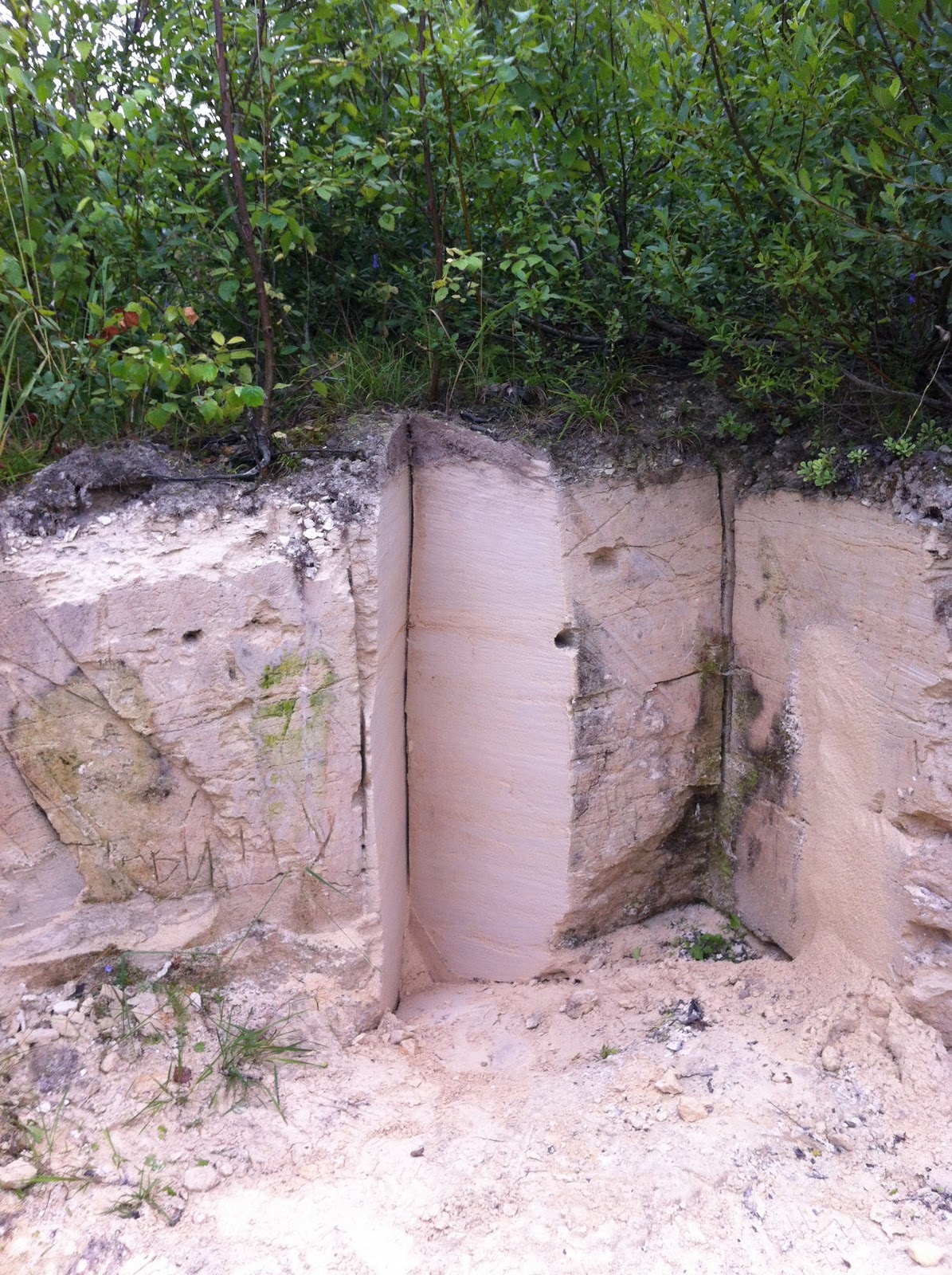
Figure 19: Microdetrital carbonate sediments (beige-colored, carbonate sand) are exposed here in a local quarry. This rock had been used for more than 100 years for renovations in St. Petersburg and the surrounding area. Some of the quarried stone was even used to mend Kazanskiy Cathedral.
Figure 20: Closeup of carbonate sediments, this time cut for geological sampling. Annual layers are visible even at this distance. These layers formed as lake productivity fluctuated between summer and winter months, much like varves. Numerous shells of molluscs (mostly snails) tell their own story of how lake levels fluctuated during the early Holocene. The lake drained very near or before the Holocene Climate Optimum, and the valley is now cut by the modern Izhora River.
Although the prior existence of a lake that is no longer there may seem to imply wetter conditions, the formation of the lake actually resulted from structural deformation (small anticlinal folds) that dammed the river—not necessarily from more rain/snow. An alternative hypothesis is that this warm period was accompanied by more frequent anticyclonic circulation, which originates in the Arctic, blocks moisture from the North Atlantic, and causes severe drought. The fires around Moscow in Summer 2010 were the result of such circulation patterns. If future warming increases the frequency of drought, local agriculture may suffer accordingly. According to analyses of instrumental records over the past 250 years, the city of St. Petersburg has warmed by 1°C more than major cities of western Europe. Since the shorter, less productive growing season of Northwestern Russia is more sensitive to drought, this hypothesis needs to be resolved soon.

Figure 21: Ordovician limestone bedrock, responsible for the topography of the Izhora Plateau, as well as its rich soils.  This rock also hosts the cleanest groundwater of the region, including the springs that fed Peter the Great's summer palace. This picture is more for looks than anything, as it strongly contrasts the sort of outcrops I am used to seeing back home. 
Figure 22: Pristine and crystal clear lakes, as promised.
And thus ends my brief geological tale—scattered and disorganized perhaps as the political history of Russia. I will leave you only with two eerie markers of a more recent 'upturning' near the Izhora Plateau. Like those great sheets of ice, remnants of the Russian Revolution are ubiquitous and unmistakeable. That advancing wave erased some memories in favor of others and left much of the political and economic landscape bare, yet still fertile for growth and new ideas. Attitudes toward that era are still mixed among the populace, but it shaped this region no less than the walls of ice that preceded it by more than 20,000 years.

Figure 23: Lenin was far more than a cultural icon here. His image symbolized hope and freedom. 
Figure 24: For the most part, 'Noble' cottages like this one did not survive the 1917 revolution. With haunting scenes like this one dotting the landscape south of St. Petersburg, that year will long be fresh in the cultural memory.
Catching the last train home...